Showing posts with label Blanket Flower. Show all posts

Sunday, August 28, 2022

Mosaic Monday #188: Garden Gala 2

And there's more!  If you enjoyed last week's post, you will be drooling over this one!  July is the best month for the native plants, especially toward the end of it.  I wish I could distill July into a genie's lamp, and poof it into existence when people come to visit at other times of the year.  I want them to see the garden in all its July glory.  Perhaps I will just show them this post ... although in my heart I know it is not the same as seeing the real thing.

To the left is Rocky Mountain Penstemon, with Paintbrush in the background.

Keeping with the purple theme, below is Walker's Low Catmint and Salvia May Night.  Both have terrific symmetry and a compact nature that is pleasing to the eye.  I have several Catmint "volunteers" - I am just waiting for them to get big enough to move to other spots in the garden.  And I have been delighted this summer to find at least two Salvia "volunteers".  Isn't Nature just the best propagator of them all?

The collage below has a better view of the Salvia, with Aspen Fleabane in the foreground.  The other photo puts the Fleabane in the spotlight, with Paintbrush bringing up the rear.


Blanketflower.


The first year the native grass seed/flower seed blend sprouted, we had numerous orange and red poppies, plus some pink ones.  We have seen very few since, except this one that came up within the "formal" flower beds.  I will take it!  The groundsel occurs naturally, and I saw it on one of my many walks. 


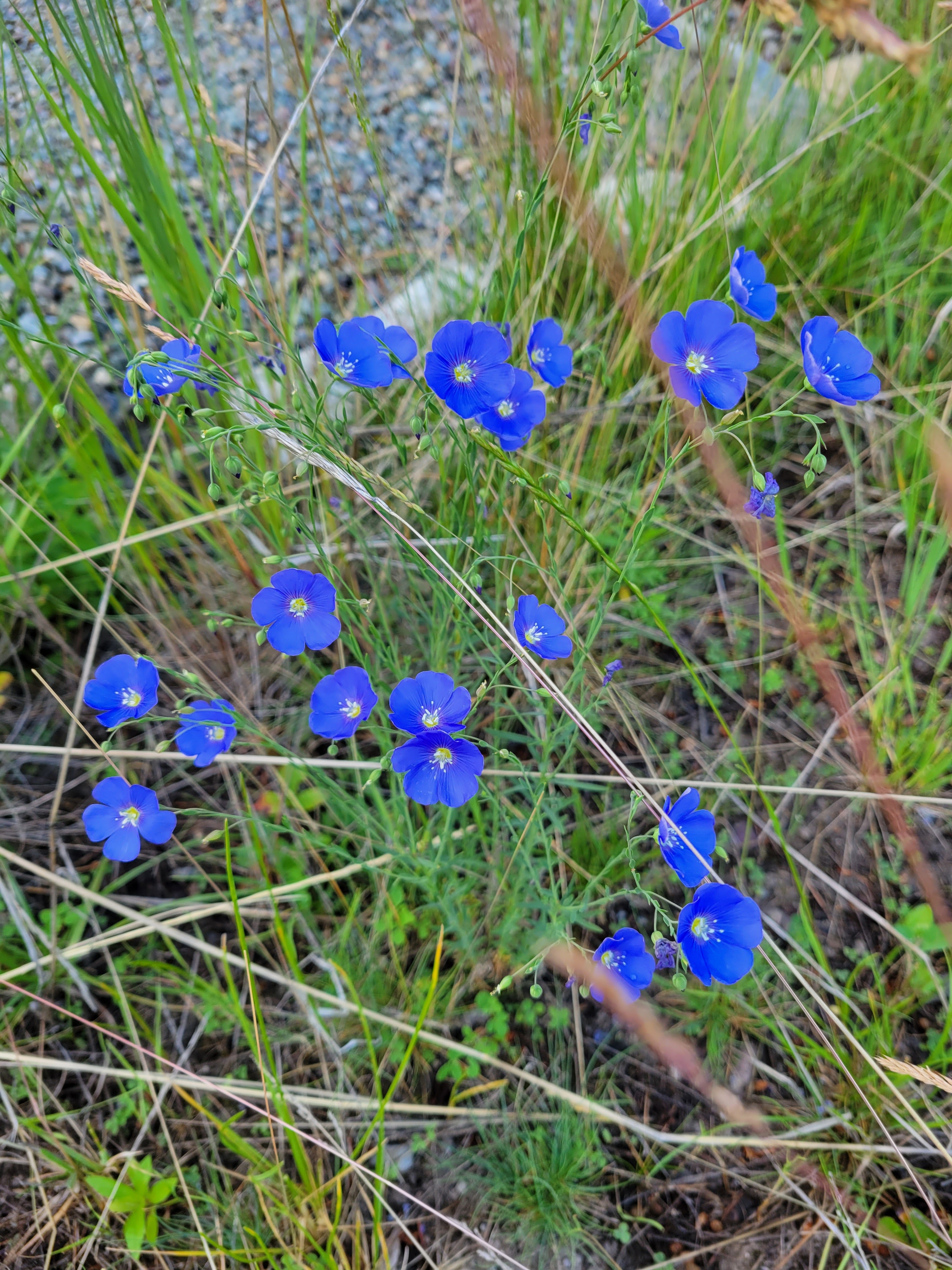
In last week's post, I might have mentioned that I am obsessed with the blue of the Flax?


I am also enamored with the sea of Coreopsis that blankets the rock steps below our kitchen and dining room.  It doesn't look like much now, but in mid-July it is nothing short of glorious.


As July marches on, the Prairie Coneflower and Bee Balm come into their own.


Harebell can be found throughout our property, but usually I only find one bloom per stem.


We have two Mock Orange bushes.  One had barely bloomed until this year, and the one below had twice the blooms as previous years, which I attribute to the abundant spring rainfall.


Toward the end of July, the Goldenrod bursts into color.  I remember, as a child, thinking of Goldenrod as quite ordinary, a plant found on abandoned parking lots, among broken glass and discarded beer cans.  Now I know better.  Like many things, a plant needs the proper environment to be at its best!


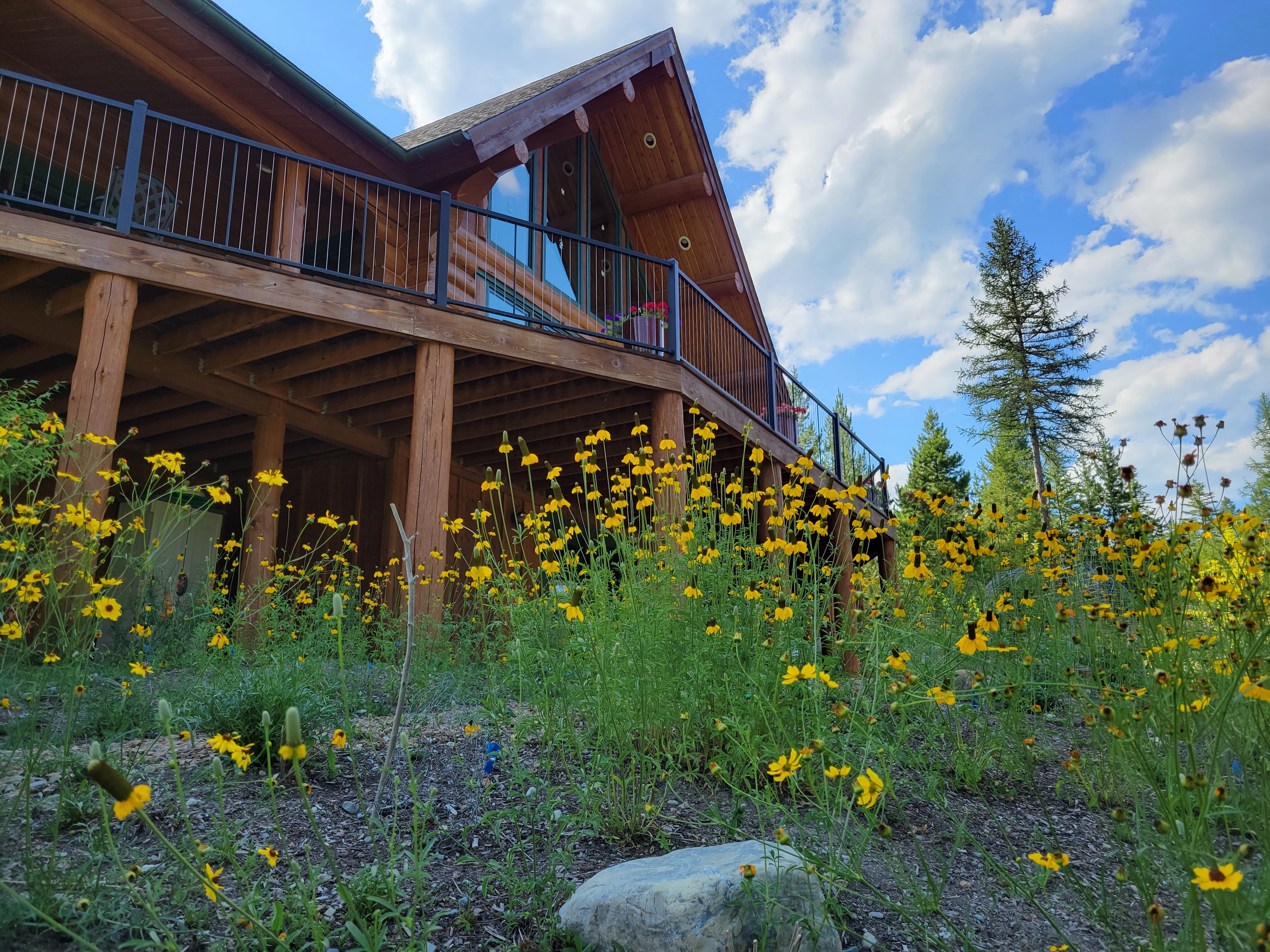
Mexican Hat first appeared in the prairie in the summer of 2019, and it is propagating across our property quite nicely!


Black-eyed Susans also arrived as part of the native grass/flower blend, and the simplicity has its own beauty.


And sometimes you find an interesting blend - two species cross-pollinating?


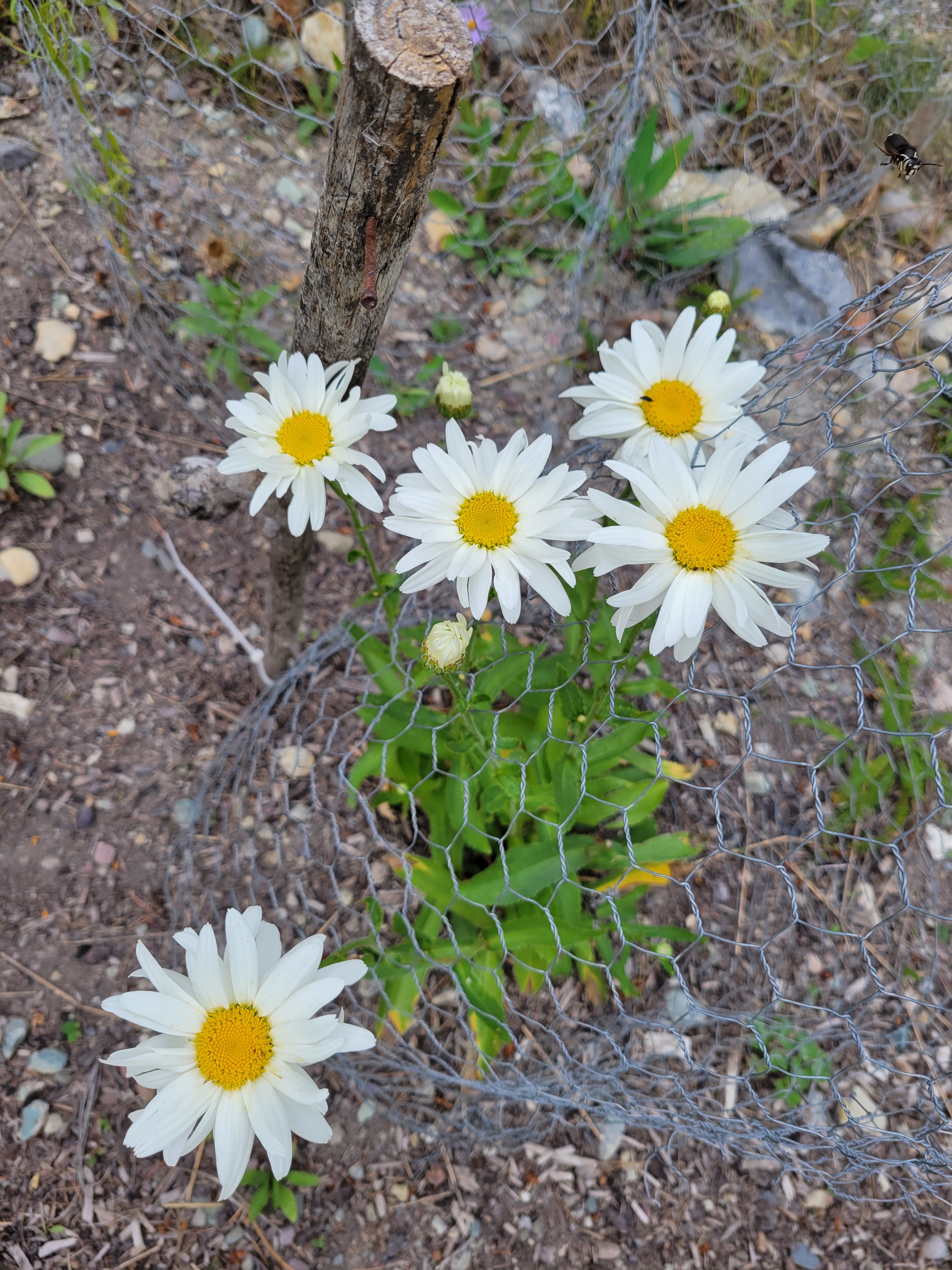
White daisies, another gift from the prairie blend, have long-lasting blooms.


Aster and Russian Sage are the last plants to bloom, and they do put on a show!


Meanwhile, the grasshoppers seem to be more prolific this year, and one of their favorite hang-outs is the Russian Sage, nipping off the top three to four inches of the majestic flower spikes.  Another opportunity to remind myself that they, too, are part of the ecosystem!


*** I will be slow in commenting due to a backcountry camping trip!

Welcome to Mosaic Monday, a weekly meme where we get together to share our photo mosaics and collages.
Please include at least one photo mosaic/collage in your post.
The link will be open from 1 p.m. Sunday until 11 p.m. Tuesday (U.S. Mountain time).
Remember to add the link to your Mosaic Monday post and not the one to your blog.
Please link back to this post so that your readers will be able to visit and enjoy more wonderful mosaics; taking the MM blog button from my sidebar is an easy way to link back.
As host I will visit every participant and leave a comment so that you know I stopped by.
Please try and visit as many other blogs as you can, especially those that join in later, so that everyone's creativity can be appreciated fully.
Thank you for joining in today and sharing your mosaics with us.


You are invited to the Inlinkz link party!

Click here to enter

Sunday, September 26, 2021

Mosaic Monday #149: Golden Days of Autumn

It's 8 am, and the sun edges over the hillside to my far right - every day, its appearance is later, and the arc of its daily journey is lower and lower in the sky.  The golden coats of the aspens seem lit from within, a satisfactory outcome of shorter daylight hours and cooler temperatures.  Mist rises in lazy curls from the lake's edge, as the warmer air over the water encounters the cooler surface of the land.  Autumn has arrived, and I like it.


Numerous plants in my garden offer their seeds to all those who would help with propagation - birds, the wind, me, and perhaps even the grasshoppers.


Plenty of blooms remain in the garden, whether from plants that produce all summer, fall bloomers or young specimens that got a late start.


Many of my fellow bloggers showcase the beauty of their gardens with cut flowers displayed in stunning arrangements.  I will admit to envy.  Until this year, I did not feel comfortable harvesting any flowers, reckoning that every cut flower represented lost propagation opportunity.  At a dinner party we hosted last week, I created a few posies with Aster, Prairie Coneflower, Russian Sage, Yellow Clover, White Clover, Aspen leaves, and Kinnikinnick branches with berries.  I am learning what has staying power as a cut flower - Russian Sage is long-lasting; Aster?  Not so much!

Wild mushroom hunters know that Autumn brings the prime season for collecting these delectables.  Make sure you know your varieties, and pick responsibly.  (Shaggy Mane Mushrooms first appear as white cylinders emerging from the ground, then the bell-shaped caps open out.  Shaggy Manes should not be eaten raw.) 


Autumn is as predictable as taxes, but Nature can still bring pleasant surprises.  On June 22, a friend gave me some Autumn Crocus (Colchicum Autumnale) bulbs.  Autumn Crocus?  I had never heard of an Autumn Crocus!  I planted them and gave them a little drink every three weeks or so.  Imagine my delight when they started to emerge on September 14!  Here's how they look today.


But we can be honored witnesses of these miracles only if we are IN Nature.  This week, Dear Neighbor Friend and I braved the morning frost and fog to kayak.  The lake had a serene quality, shrouded in mist so thick we could not discern any familiar landmarks.  Only the sound of our dripping paddles accompanied us.  Slowly, the lake's margins were revealed, and we glided silently along copses held firm by Alder, wild grasses, and Red Osier Dogwood.  Hundreds of cobwebs glinted in the sun, seemingly bedazzled by a band of fairies overnight.  


I marveled at the realization that the cobwebs have always been there, but it took the mist to unveil them to us.   


Welcome to Mosaic Monday, a weekly meme where we get together to share our photo mosaics and collages.
Please include at least one photo mosaic/collage in your post.
The link will be open from 1 p.m. Sunday until 11 p.m. Tuesday (U.S. Mountain time).
Remember to add the link to your Mosaic Monday post and not the one to your blog.
Please link back to this post so that your readers will be able to visit and enjoy more wonderful mosaics; taking the MM blog button from my sidebar is an easy way to link back.
As host I will visit every participant and leave a comment so that you know I stopped by.
Please try and visit as many other blogs as you can, especially those that join in later, so that everyone's creativity can be appreciated fully.
Thank you for joining in today and sharing your mosaics with us. 


You are invited to the Inlinkz link party!

Click here to enter

Sunday, June 13, 2021

Mosaic Monday #135: Going Native

I was raised by a lawn and garden perfectionist.  Nary a dandelion to be found in my Dad's rolling Zoysia landscape.   Trees were pruned to showcase the natural architecture of the branches - my Dad's sculptures were as beautiful in the winter as they were when wearing a full coat of leaves.   His vegetable garden was just as meticulous, with ruler-straight rows and cages to keep those tomatoes in line.

Until we moved to our current home in Montana, I strived to be that gardener.

With the new construction associated with our log home, the landscape immediately around the house was a blank canvas.  In the process of making other design choices, I must have thumbed through a hundred Log Home Living magazines.  In most cases, the curb appeal of the featured homes was classic - manicured lawns, rock gardens with showy trees, and lakeside settings with trellises and gazebos.  As tempting as it was, Spousal Unit and I knew that this was not the answer for us.  

Retirement is to be enjoyed, right?  So, for a start, Spousal Unit declared that his last lawnmower would not be coming with us.  OK.  Check.  No formal lawn.  

As for me, I would also want freedom in the summers for hiking, camping, kayaking -- well, you get the point.  So, something low maintenance was in order.

Ever since we lived in Arizona, I have had an aversion to sprinkler systems.  If one is needed regularly, it means the plants in the landscape are not native, not adapted to the rainfall that is normal for the area.  That was it -- I wanted to go native.

"Water, water, water ... There is no shortage of water in the desert but exactly the right amount, a perfect ration of water to rock, water to sand, insuring that wide free open, generous space among plants and animals, homes and towns and cities, which makes the arid West so different from any other part of the nation.  There is no lack of water here unless you try to establish a city where no city should be."  -- Edward Abbey

We are three years into this gardening adventure, and I am still learning.  Recently, I had the opportunity to attend a webinar entitled "Conservation Gardening: Landscaping with Montana Native Plants for Montana's Native Wildlife."  Led by David Schmetterling, the webinar covered how to landscape with resource conservation, drought and wildlife in mind.  His "laboratory" was a small city lot around his Missoula, Montana home.

I was enlightened.  Going native is not just about the plants, but the entire ecosystem.  Yes, even the insects, even those who want to eat my plants.  He shared a story about paper wasps who score the bark of aspens to make their large paper nests.   Aspen beetles use the scars to lay eggs.  In the spring, as larvae hatch, ants are there to eat some of them.  The tree responds to the scar by oozing sap, an early food source for butterflies before flowers are blooming.  In other words, if I eradicated the paper wasps, I would impact three or more other species!!!

I resolved to look at my garden differently this spring.  Insects on native plants would be left to their devices.  Infestations on non-natives would be addressed. 

Fairly quickly, I had an opportunity to test myself.  On May 31, I observed some irregularity on the goldenrod, and closer inspection revealed this black and white caterpillar. (I put it on the rock only to get a photo.)  You would be so proud of me - I left it there on the rock!  Of course, anything living has to have a name, so I embarked into the world of caterpillar identification.  Thirty minutes later, I was none the wiser.  It could be an asteroid, the brown-hooded owlet, the camouflaged looper, the common pug, the striped garden caterpillar or the goldenrod gall moth.  Didn't look like any of them!  Spousal Unit suggested I give it a name, so Montanas Angelas it is!

By June 8, I had already lost my resolve, partly because Spousal Unit expressed a concern that the goldenrod would not flower properly.  A few caterpillars were sacrificed, but I didn't touch the few aphids that I found on the goldenrod, or the spittlebugs with their cocoons of spit.

I can take some consolation in my approach to the golden currants -- I did not spray the aphids that massed on the fresh growth on May 31.  And now I can report that the aphids are gone, with no apparent damage.  Lesson learned!


I have written extensively in the past about my attempts to deter the deer and other critters.  I believe I have finally found an effective solution.  This sprinkler features a built-in motion detector, which prompts it to go off suddenly with two full arcs.  I know it frightens me when I forget it's there and I wander into range!  Four have been placed in strategic locations, and the deer no longer come into the main section of the landscaping.  Of course, nothing is foolproof - a female turkey did a number on several of my chive plants by walking in between the sprinklers,  C'est la vie - I'll take it!


Ever since the first time I saw lupines in bloom, I have been longing to have them on my property.  Last May, Dear Neighbor Friend and I transplanted 27 lupines.  As the summer wore on, they all seemed to die.  It was a long shot -- everything I read indicated that lupine don't like their roots to be disturbed.  So, I bought some lupine seeds, and planted them in over 35 spots around the garden.  I have been so pleased with the results - all but four spots sprouted one or more lupine.  AND, as I have been making my rounds, I have discovered that some of the transplants have grown as well!!!

From this seed-planting experience, I have also learned that it doesn't take much magic to get results.  I tossed (literally) some seeds behind our jack-leg fence, and in an open area to the left of the fire pit.  Both areas have yielded a bumper crop of baby lupines!!! They are tiny now, but in years to come, they will put on a majestic spring show!


With the benefit of hindsight, I might wish that I had not agreed to include non-natives in the landscaping.  For example, the sand cherries have suffered die-back every spring.  Last year, I carefully clipped a "diseased" portion and engaged Montana State University.  The experts there advised pruning and sanitizing the shears after each clip.  Well, here we are again with die-back.  This year, I am going to leave it and see what happens.


Similarly, the Norway Maple has been on a slow downward spiral ever since it was chowed by elk the first year.  This spring, it has not leafed out, and I am declaring it dead.  We have not decided what will replace it, but you can be sure it will be a native plant!

Gardens can also benefit from structures for visual interest and texture.  This summer, we have added "lawn art" in several locations.  We are still looking for a large piece, to be placed in the middle of the leach field.  In our mind's eye, we envision part of an old tractor, or perhaps a windmill from a dis-used ranch.


Jokingly, I often ask Montana natives how long you have to live here to qualify.  They chuckle, and politely change the subject.  So, when I read this sentence in the book "Braiding Sweetgrass: Indigenous Wisdom, Scientific Knowledge, and the Teachings of Plants" by Robin Wall Kimmerer, I was over the moon.  "For all of us, becoming indigenous to a place means living as if your children's future mattered, to take care of the land as if our lives, material and spiritual, depended on it."  Now that, my friends, I can do. 


Welcome to Mosaic Monday, a weekly meme where we get together to share our photo mosaics and collages.
Please include at least one photo mosaic/collage in your post.
The link will be open from 1 p.m. Sunday until 11 p.m. Tuesday (U.S. Mountain time).
Remember to add the link to your Mosaic Monday post and not the one to your blog.
Please link back to this post so that your readers will be able to visit and enjoy more wonderful mosaics; taking the MM blog button from my sidebar is an easy way to link back.
As host I will visit every participant and leave a comment so that you know I stopped by.
Please try and visit as many other blogs as you can, especially those that join in later, so that everyone's creativity can be appreciated fully.
Thank you for joining in today and sharing your mosaics with us.


You are invited to the Inlinkz link party!

Click here to enter

Saturday, September 19, 2020

Mosaic Monday #97: Gone to Seed

I am feeling a little under the weather.  Maybe it's a side effect from the second part of the shingles vaccine that I took yesterday.  Or perhaps it's a type of seasonal affective disorder, brought on by the ongoing smoky environment and the shortening days.  As I thought about writing a blog post this week, it took some effort to screw up the energy to do it.  I decided I would take an easy route, and stroll the back forty for some inspiration.  Do you suppose it is just a coincidence that most of the pictures are plants that have gone to seed? Gone to seed: showing signs of advanced wear and tear and neglect.  (Merriam Webster)

Despite ongoing spraying, thistles are abundant in our lower prairie.  A plant can produce up to 6,000 seeds that can persist in the soil for over 9 years.  As the saying goes, it's a marathon, not a sprint.  I have taken to cutting off the heads to at least halt the seed production.

The Labor Day wind storm brought down a couple of our aged aspen trees, with collateral damage on the younger aspens nearby.  A close look at the stump shows that it was becoming hollow; sawdust would suggest that termites were hard at work.  In the end, it was no contest for the 40+ mile an hour winds that day.  I used to put my trail cam near here, since the deer have worn a path through this grove of aspens.  They will have to adjust their route!  For now, they have been continuing to frequent the area to eat the aspen leaves that are suddenly within reach.


Shorter days and lower night-time temperatures are wielding Nature's paintbrush, revealing yellows, oranges and reds that have been hidden by abundant chlorophyll.


Not everything in my world of Nature is rolling up the carpets for the winter.  I can't tell you how many of these ant hills we have around our property, but I can tell you that they are still very active, as you can see in the video below.  I could spend hours watching this activity and trying to make some sense of it.  How tall does the hill need to be for it to be done?  Are any of the sticks food?  If not, who is focusing on the food part of the equation?  

I have written before about the beaver family that occupies the lake at the bottom of our property.  When the beavers moved in, they applied their superior engineering skills and very effectively dammed the creek and raised the water level.  While this is a boon for the wetland ecosystem around the lake, it had the undesirable consequence of dramatically reducing water flow to several of our neighbors, some of whom rely on the water for their cattle.  The battle of the brains began, man versus rodent.  How to restore some water flow without impacting the beaver, and in a way that the beavers would ignore?  Initially, every solution the team created was thwarted by the beaver; ditches were filled in overnight, pipes with holes were plugged with mud, strategically placed boards were removed and added to the dam.  It was equal parts funny and frustrating.  At this point, it seems the latest man-made engineering feat has worked, but only time will tell.  On my last visit to the dam, I observed that the beaver has begun constructing a secondary dam, 15 feet below the original dam.  It has not stopped the water flowing into the creek, but I am not sure the critters are done yet!  Watch this space!


If you look hard enough, you can also find some plants with blooms. 

I try to ignore for the moment that the daisies and knapweed are considered invasive here.  If I get too focused on them, this walk would turn into a weed-pulling exercise rather than the diversion it is meant to be!

Update: it has been a couple of days since I started this post, and I am glad to report that, physically, I am back to myself.  I do think it was the vaccine; no regrets about taking it, but it just reminds me that I do not make a good patient!  Mentally, I am still working on my attitude.  The forecasted rain for last night and today has not materialized; the skies are gray and the smoke lingers.  Logically, I know I should count my blessings and find myself a rich woman.  Thinking that music often helps bring me around, I went looking for "autumn" songs, and came across "September" by Earth, Wind and Fire.  I hope this post finds you well, but if you need a little pick-me-up, maybe this will lift your spirits and send your toes tapping!

Welcome to Mosaic Monday, a weekly meme where we get together to share our photo mosaics and collages.
Please include at least one photo mosaic/collage in your post.
The link will be open from 1 p.m. Sunday until 11 p.m. Tuesday (U.S. Mountain time). 
Remember to add the link to your Mosaic Monday post and not the one to your blog. 
Please link back to this post so that your readers will be able to visit and enjoy more wonderful mosaics; taking the MM blog button from my sidebar is an easy way to link back. 
As host I will visit every participant and leave a comment so that you know I stopped by. 
Please try and visit as many other blogs as you can, especially those that join in later, so that everyone's creativity can be appreciated fully. 
Thank you for joining in today and sharing your mosaics with us. 


You are invited to the Inlinkz link party!

Click here to enter
Related Posts Plugin for WordPress, Blogger...