And there's more! If you enjoyed last week's post, you will be drooling over this one! July is the best month for the native plants, especially toward the end of it. I wish I could distill July into a genie's lamp, and poof it into existence when people come to visit at other times of the year. I want them to see the garden in all its July glory. Perhaps I will just show them this post ... although in my heart I know it is not the same as seeing the real thing.
To the left is Rocky Mountain Penstemon, with Paintbrush in the background.
Keeping with the purple theme, below is Walker's Low Catmint and Salvia May Night. Both have terrific symmetry and a compact nature that is pleasing to the eye. I have several Catmint "volunteers" - I am just waiting for them to get big enough to move to other spots in the garden. And I have been delighted this summer to find at least two Salvia "volunteers". Isn't Nature just the best propagator of them all?
The collage below has a better view of the Salvia, with Aspen Fleabane in the foreground. The other photo puts the Fleabane in the spotlight, with Paintbrush bringing up the rear.
Blanketflower.
The first year the native grass seed/flower seed blend sprouted, we had numerous orange and red poppies, plus some pink ones. We have seen very few since, except this one that came up within the "formal" flower beds. I will take it! The groundsel occurs naturally, and I saw it on one of my many walks.
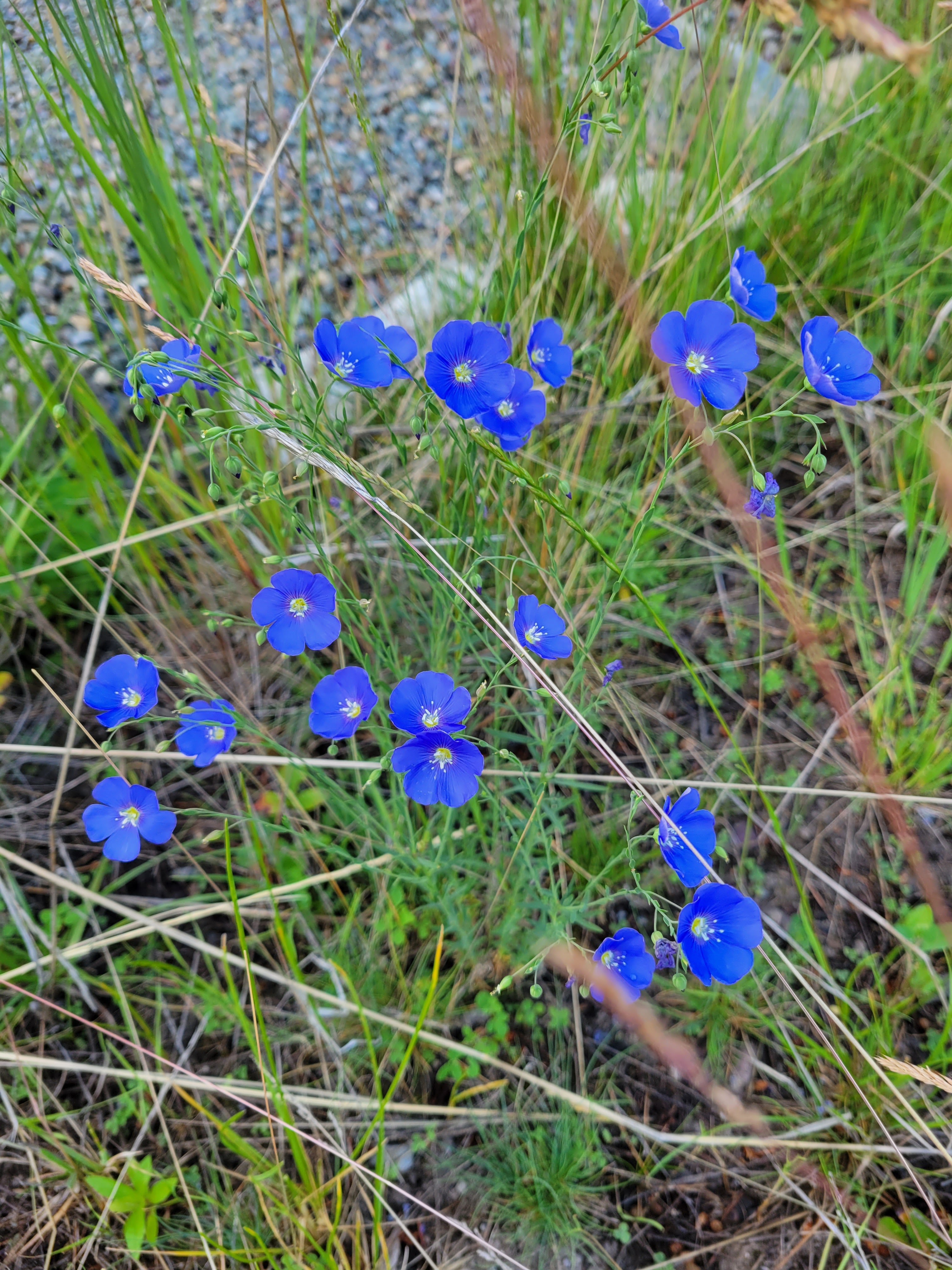
In last week's post, I might have mentioned that I am obsessed with the blue of the Flax?
I am also enamored with the sea of Coreopsis that blankets the rock steps below our kitchen and dining room. It doesn't look like much now, but in mid-July it is nothing short of glorious.
As July marches on, the Prairie Coneflower and Bee Balm come into their own.
Harebell can be found throughout our property, but usually I only find one bloom per stem.
We have two Mock Orange bushes. One had barely bloomed until this year, and the one below had twice the blooms as previous years, which I attribute to the abundant spring rainfall.
Toward the end of July, the Goldenrod bursts into color. I remember, as a child, thinking of Goldenrod as quite ordinary, a plant found on abandoned parking lots, among broken glass and discarded beer cans. Now I know better. Like many things, a plant needs the proper environment to be at its best!
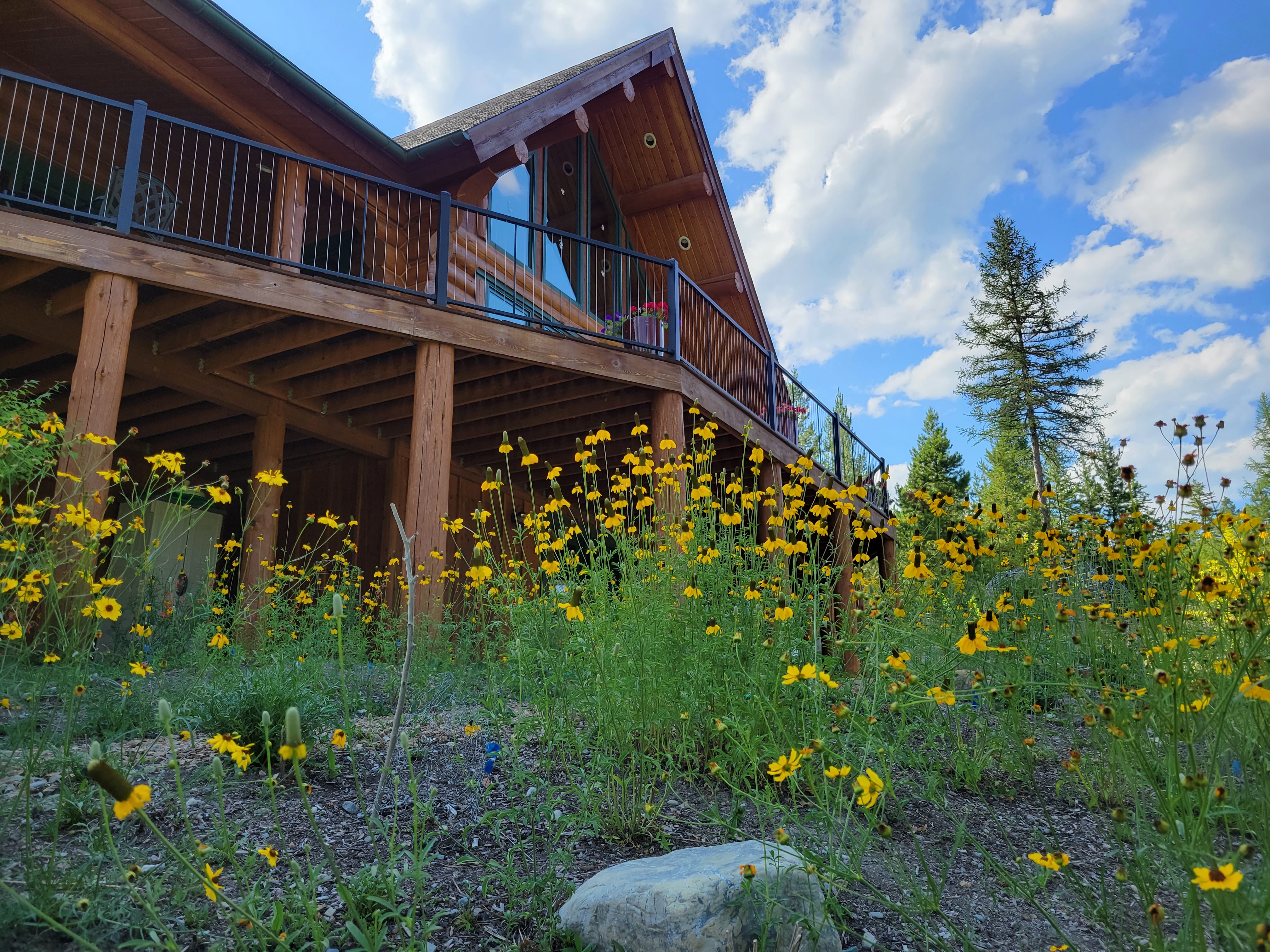
Mexican Hat first appeared in the prairie in the summer of 2019, and it is propagating across our property quite nicely!
Black-eyed Susans also arrived as part of the native grass/flower blend, and the simplicity has its own beauty.
And sometimes you find an interesting blend - two species cross-pollinating?
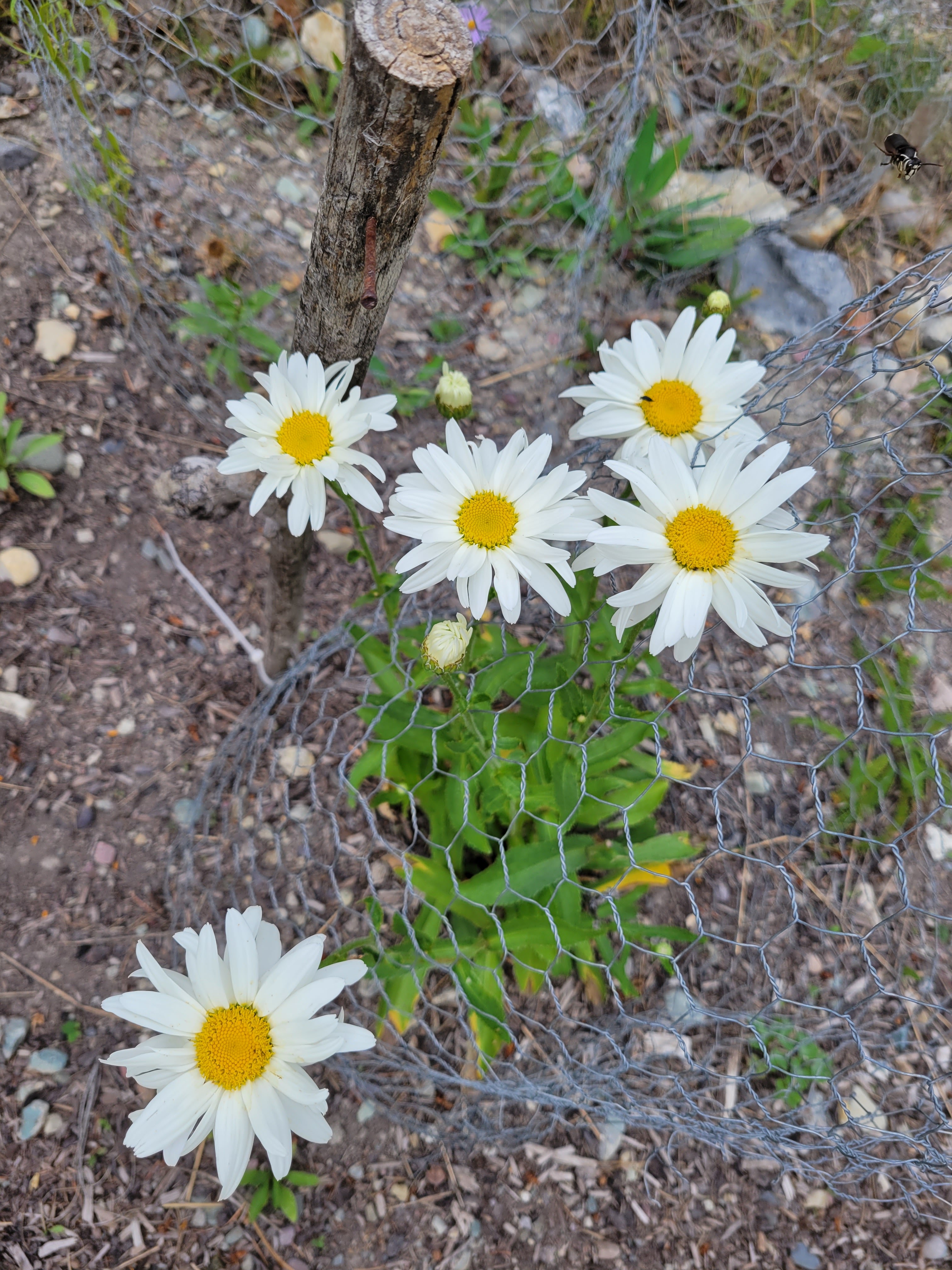
White daisies, another gift from the prairie blend, have long-lasting blooms.
Aster and Russian Sage are the last plants to bloom, and they do put on a show!
Meanwhile, the grasshoppers seem to be more prolific this year, and one of their favorite hang-outs is the Russian Sage, nipping off the top three to four inches of the majestic flower spikes. Another opportunity to remind myself that they, too, are part of the ecosystem!
*** I will be slow in commenting due to a backcountry camping trip!
Welcome to Mosaic Monday, a weekly meme
where we get together to share our photo mosaics and collages.
Please include at least one photo mosaic/collage in your post.
The link will be open from 1 p.m. Sunday until 11 p.m. Tuesday (U.S. Mountain
time).
Remember to add the link to your Mosaic Monday post and not the one to your
blog.
Please link back to this post so that your readers will be able to visit and
enjoy more wonderful mosaics; taking the MM blog button from my sidebar is an
easy way to link back.
As host I will visit every participant and leave a comment so that you know I
stopped by.
Please try and visit as many other blogs as you can, especially those that join
in later, so that everyone's creativity can be appreciated fully.
Thank you for joining in today and sharing your mosaics with us.
Labor Day in the U.S. conjures memories of warm sunshine and family barbecues, the last hurrah before summer ends. Labor Day 2020 in Northwest Montana brought high winds, small hail and a night-time frost. And just like that, our already abbreviated growing season came to an abrupt halt for much of my garden. As it is impractical to cover an entire landscape as protection from frost, I woke Tuesday morning and approached the garden with one eye open, expecting widespread damage. Of course, I have been known to imagine the worst, so maybe I should not have been surprised to discover that more than half of the plants were unaffected. I believe this is another benefit of native species, especially those in Montana. Like our hardy residents, they don't shrink and wither the first time the temperature gauge dips below 32!
But even so, I got Mother Nature's message, and decided I should show you my garden before it truly goes to sleep for the winter. Join me for a prance through my prairie!
I discovered Rocky Mountain Bee Plant last year, growing naturally. Seeds I sowed in the fall sprouted, and the most successful plant loomed to five feet before the frost brought it down. Aptly named, it is a magnet for bees, butterflies and hummingbirds; you could hear the incessant drone of buzzing from quite a distance. Overnight, the pollinators have vanished from this plant. I have already collected seed pods, and will continue to do so as more mature - I can't count on this plant to return since Bee Plant is an annual. I look forward to continuing my experimentation with this gorgeous member of the caper family.
By mid-August, my driveway baskets were past their prime, so I augmented them with Lamium, Anemone, and Angelface Summer Snapdragon. Despite covering them the night of the frost, the most delicate plants succumbed. Sigh. On the porch, the cold devastated the black susan vines that looked so pretty twining around the railings. I don't plan to use them again, since their connection to the railing prevents me from moving them in the case of hail (or frost)!
Aster showed no impact from the frost, and since it is a late bloomer providing welcome splashes of color in the garden right now, I am pleased. My aster plants (I think the initial landscaping plan had four or five) have spawned innumerable volunteers, and it appears to be a favorite of the deer since many of the seedlings are nibbled before they produce flowers. I am still occasionally surprised where I find the plants - the seeds are so small, I can only attribute it to the vagaries of the wind. When I locate one in a particularly desirable location of the garden, I make sure to protect it!
Speaking of welcome surprises, I have been thrilled to find paintbrush volunteers in at least five places. Why is this significant? Paintbrush is a hemiparasitic plant - it seeks out roots of host plants, usually grasses, and taps into them for nutrition. So, I had concluded that it was just unlikely that my mama paintbrush would reproduce! As it turns out, the volunteers are growing close to or underneath other plants, but none of them are grasses. It has emboldened me to attempt planting some seeds this fall! (and the frost did not affect them- yay!)
I was also delighted to discover a coneflower with magenta florets within the boundaries of my "formal" garden. It first appeared last summer in the prairie, and clearly some seeds found their way into the flower beds. Its stalks and leaves are remarkably similar to those of the prairie coneflower, so I had mistakenly labeled them as such, until they bloomed. I have studied my plant books, and perused the web, but I have been unable to make a formal identification. Can anyone help? Until then, I am mentally referring to them as magenta coneflower. Update: thanks to MB of Small City Scenes and Pat of Mille Fiori Favoriti for helping me identify this as Mexican Hat/Upright Prairie Coneflower. (In general, the coneflowers are more droopy following the frost.)
Several other plants have also performed well with self-propagation, including the goldenrod. I was amazed to locate one among the gilia and blanketflower. I have also learned that it is easy to confuse goldenrod and fireweed, especially when they are small. Goldenrod tends to have one stem; fireweed is likely to have multiple branches as it grows. What they have in common is that the deer love them! (Fireweed is an important colonizer of burned areas. It spreads rapidly by seeds and buried rhizomes. When bombs levelled parts of London in WWII, fireweed appeared in the heart of the city for the first time in generations.) The goldenrod and fireweed were unfazed by the cold.
As the summer has progressed, I have also marked many spots containing what I believe to be volunteer bee balm. If I am correct, I will be quite happy since it has been hard for me to harvest seed from this plant - as soon as it is done blooming, the whole plant turns brown, and I have been unable to identify anything that looks like a seed!
As many of you know, bee balm is another plant that draws pollinators in droves. Below is a video of butterflies on and around the plant.
As long as we are looking at videos, check out the hummingbird with the scarlet gilia. For weeks, this female hummer was guarding this section of the garden by sitting on the chicken wire in between feedings. (The gilia showed no reaction to the initial cold snap.) You may have noticed the blanketflower that is mixed in with the gilia. This plant has a special corner of my heart - it seems to bloom continuously with that eye-catching yellow/orange combination. Also, it was unaffected by the frost, its seeds are easy to collect, and I had great results with the seeds that I sowed in the spring. A keeper!!!
Let's pause for a moment and talk about critters. Deer continue to be a nuisance. Other than chicken wire/fencing, all of my methods for deterrence have had very limited success (including the deer repeller I wrote about on 9/8/2019). As the garden self-propagates, it is more and more impractical to protect individual plants. I have had some success with placing chicken wire around large sections, such as the gilia and blanket flower you have seen in some of the pictures above. I think my next plan is to move those large chicken wire enclosures from year to year, allowing a new section to get well-established. We can only try, right?
On July 23, I found aphids on the Norway Maple. I consulted with the experts at Montana State University, and they recommended washing them off with insecticidal soap. Realizing that I can't reach all the leaves, my contact reassured me that all trees have some aphids, and that there are lady beetles, lacewings and parasitoid wasps that will come in to control the aphids. I am inclined to take their advice since I have seen a complete recovery for my sand cherries since I pruned them per their guidance (see below). August 9, I chased a bunny from the front flower bed, and I have not seen it since. And, as usual, the ground squirrels went into hibernation in the middle of August. One less thing to worry about!
Admired for its silvery gray, fragrant foliage as much as its lavender-purple flowers, Russian sage make a bold statement in a garden. The abundant, spiky clusters of flowers only started blooming in mid-August, so I was a little chagrined to see that some spike tips were affected by the frost. Also, the wind has weakened some of the branches and spoiled the normally symmetrical look. Nevertheless, all three of my plants are spectacular, and I love the show. They have also produced a number of volunteers, and I have learned NOT to water them - Russian sage likes very dry conditions.
Another implication of a short growing season is a lack of time for a second bloom. For both Catmint and Salvia, it is suggested that shearing/deadheading can produce a second bloom. I have been watching the Catmint carefully, and as recently as a week ago, it still had blooms frequented by bees, which makes me hesitate to shear it. At this point in the season, it would be fruitless to try for a second bloom. In fact, with some plants, you should stop deadheading to allow the plant to focus its resources on preparing for winter. I deadheaded the Salvia at the beginning of August and one plant out of three has produced a few new blooms. I think next year I will try trimming it lower on the stalks and supplementing with some additional water. (Neither the catmint or the salvia were harmed by the frost.)
I have been very pleased with the performance of the Black-eyed Susan plants, and it is a direct result of guarding. I ran my own experiment, and most of the Susans that were not protected were nibbled, especially the flower buds!
Susans are also prolific in the prairie, as a result of the seed mix we planted in the fall of 2018. It is hard to capture in a photo, but you can see a few of them below, among the naturally-occurring yarrow. (The tallest Susans were hard hit by the frost. I was able to protect some of the shorter ones with a few strategically placed buckets. These pictures were all taken before the cold snap.)
As I walk around the prairie, I keep my eyes peeled for other treasures. I am pretty sure the daisy* and larkspur were in the seed mix, but the harebell is so plentiful in the woods around here that I am sure these seeds were already present. And the Oceanspray is a shrub that has clearly been here for quite a few years. It is the only one that I have seen on our 15 acres! *oxeye daisies are considered invasive in Montana, so I pull them up when I see them
I have been doing some reading about prairies, generating some ideas that are part of my garden planning for next season. But this post is already long enough, so I will start to draw to a close with some photos of the Coreopsis that has exploded on the southeast side of the house.
The soft tissues of the Coreopsis were blackened by the frost, but some of it close to the ground is still alive. Even before the cold snap, the plants had produced drifts of seeds visible on the stone steps. Birds, especially pine siskins, perched delicately on the stems to pick out the miniscule morsels, and flew off in a pack when you opened the mud room door. I suspect I will be plucking hundreds of volunteers next spring! Before then, these beds will be subject to significant thinning/transplanting; some of these plants may find new homes in the rock garden at the front of the driveway. By far, that bed has been my biggest disappointment this summer, but you know me -- I have MAJOR plans and HOPE springs eternal!
Dedicating my prayers today to all those suffering the impact of wildfires, hurricanes, and flooding.
Welcome to Mosaic Monday, a weekly meme
where we get together to share our photo mosaics and collages.
Please include at least one photo mosaic/collage in your post.
The link will be open from 1 p.m. Sunday until 11 p.m. Tuesday (U.S. Mountain
time).
Remember to add the link to your Mosaic Monday post and not the one to your
blog.
Please link back to this post so that your readers will be able to visit and
enjoy more wonderful mosaics; taking the MM blog button from my sidebar is an
easy way to link back.
As host I will visit every participant and leave a comment so that you know I
stopped by.
Please try and visit as many other blogs as you can, especially those that join
in later, so that everyone's creativity can be appreciated fully.
Thank you for joining in today and sharing your mosaics with us.
Blue flax - from wildflower seed scattered last fall
I have so much to share with you, dear friends. The ongoing transformation of my garden. My burgeoning knowledge about the plants in
this region. The challenges of gardening in
the woods with critters of all kinds. My embryonic plans for next year’s
garden. Are you seated comfortably? Then let’s begin. In my previous garden posts (June 9 and July 21), I have featured
70% of my formal plantings.Today you
will see the remainder, again through collages illustrating their progression
since the snow melted! (Click on the collage to make it bigger.)
I always thought of Goldenrod as "common" - but it has
"grown" on me - LOL!
Bee Balm was in my June 9 post, but before blooming
Coreopsis - in the upper middle photo, the plants are
barely visible. They exploded into my most prolific plant,
all by self-seeding. I transplanted many of them just to
make the flower bed look a little more shapely (lower middle
shot is "after"). This is also the plant most plagued by deer.
Aster - far right plant was drastically nibbled by deer
earlier this summer - silver lining? Abundant flowers
on the ends of multiple stems
Prairie coneflower - I love this plant. Began blooming in
mid-July and is still full of color. Knock on wood, deer
don't bother it.
Goodland apple - I wrote about the apple trees in my
June 9 post - at that time, they were still in flower. The
Goodland has 12 apples. We beefed up the protection on
this tree after the 1 small apple on the Honeycrisp
disappeared. Suspect? Chipmunks.
Scarlet Gilia - given its delicate nature last summer, I was surprised it returned at all.
I have since learned by observation that it does not grow back from its base, but only
by self-seeding - we must have over 140 "volunteers". I have also learned from visiting
the nursery that it will not flower this year but next.
Russian Sage - another love. As you can see, it grows back from its base and becomes
this sprawling web of purple. And the deer don't bother it.
Black-eyed Susan: another plant that returns only via self-seeding. It takes a keen eye to spot
these "volunteers", and some patience to see how they develop before deciding to keep or
to pluck. Shortly after the last picture, deer came along and ate this bloom and several of
the buds closest to opening. Grrrr ….
Speaking of deer – perhaps it is obvious that our “deer defense”
system has ceased to be effective.I
guess those clinking beer/cat food cans are now music to their ears!Few plants have been immune to their
affections, but the coreopsis below the mudroom has been nibbled almost every
night for the last month.Good thing I
have a lot of it – I have deliberately left some sections uncovered in the
hopes that the deer will focus on those. Friday we installed an “Animal Repeller” – when it senses an animal,
it emits a high-pitched noise, and if at night, flashes a strobe light as
well. So far? Mixed results since I do have deer tracks this morning. Might need to move it slightly. This has also taught us that we need to change up the defense
system. Cans for a period, then sparkly
ribbons, then the repeller, and so on.
Black aphids also returned to the pearly everlasting and the
yellow penstemon in mid-August.The good
news?The Columbian ground squirrels
have gone into hibernation!!!At least
one less threat to deal with! As
you can see from some of these pictures, the “formal” landscaping is quickly
outgrowing its defined boundaries. I am
torn between a desire for “order”, and the joy of nature doing its thing. Just given my personality, this will be an
ongoing tussle, but I am determined to encourage a natural garden, so “disorder”
is the preferred condition. This means
allowing many plants to grow until I can figure out what they are – the benefit
is less weeding (at first)! Each time I
realize I have a new volunteer, it’s like a instant shot of joy.
It
is much easier for me to accept “chaos” in our “prairie”, which you may recall
was planted with a grass seed/wildflower seed mix last fall. It’s the gift that keeps on giving – I can
almost always find something new out there.
Clockwise from upper left: Larkspur; Coreopsis variant; Lupine; Purple Coneflower; Blue Flax; Black-eyed Susan
I learned that Blue Flax flowers last less than 24 hours. I took the above picture in the morning and I was glad I did!
Yarrow
It seems each day brings new learning for me, and from a
variety of sources. Most of it is plain observation. For example, the aster plant that was
significantly pruned by deer produced the most flowers. And once a plant is flowering, the deer don’t
eat it. And I have been amazed (and
pleased) that most of our plants are as advertised – they thrive even in our
dry conditions. Of course, the Web is a
superb source of information, but sometimes you need a fellow human, and in
that case, the Center for Native Plants has been a god-send. While
the wildflowers have been easy to identify, the grasses have been much more
difficult.
I
called Hooper’s Garden Center (which provided the grass/wildflower mix), and
they gave me a list of grasses that was included in the mix. I studied each of them, even sketching
diagrams in my garden journal, and teaching myself about grass anatomy. Unfortunately, most of them did not seem to
match the grasses outside. I reached out
to a friend who works for the Forest Service, and he recommended two sources:
the book “Plants of the Rocky Mountains” and the Center for Native Plants in
Whitefish.
I
ordered the book and it was helpful to identify some of the grasses, but I
still had gaps. So, on one of my weekly
trips to Whitefish, I stopped in the Center and talked with Sarah about my
challenge. She referred me to the nursery
manager, Hailey. She suggested Hailey
might come out to our house (for a fee plus gas), but that she might also be
able to identify the grasses just from pictures. Sold!
That night I sent off a series of emails to Hailey, and within a few
days she had responded. Most
importantly, she was able to tell me that only one of the grasses is highly
invasive.
Lower middle is Cheatgrass - highly invasive. Fortunately, I only found two small patches of it - pulled it up
carefully - trying not to spread seeds - and threw it away. Only three of these matched the list given to me
by Hooper's. Go figure!
While I am enjoying the plants which are blooming in the
garden now, half of me has already turned my attention to next year’s
garden. At the end of July, seeds were
ready to be harvested from both columbine and blanket flower plants. Since then, I have also collected the
following seeds: aspen fleabane, lupine, chives, goldenrod, nodding onion, aster,
coreopsis, rocky mountain penstemon, red poppy, bee balm, coneflower and
yarrow. It gave me great joy yesterday
to give some seeds to a friend who recently moved into her new house.
At
least half of my seeds are to be planted in the fall, so I am creating to-scale
drawings of each of my flower beds, including all the volunteers. This will allow me to decide where to augment
the landscape, taking into account size, color and the time frame for
blooming. I would like to make sure that
every flower bed has something in bloom at all times.
Red Osier Dogwood
In early August, we transformed the area near our “address
rock”. Our neighbor on the hill had
previously given us nearly 20 rocks, and had carefully arranged them in a
semi-circle using his tractor. After
driving by it numerous times, I decided for a different look, and he willingly
came down the hill with the tractor and re-arranged them in real time. And gave us a scoop of dirt. And dug a hole for a dogwood we plan to place
there. What a pal! The barter system is alive and well in
Montana; he was happy to help us out in exchange for the water he has been able
to access from our well head throughout the summer!
We will be adding some top soil to the area, and then fall seeding
will begin using the design you see below.
The Red Osier Dogwood will go in the hole – it is meant to provide some
contrast with the pines, and to anchor that end of the flower bed. A few transplants, such as juniper, will
complete the fall planting and we will let Mother Nature do her work until it
is time for spring planting of the other seeds.
I am so excited to see how this develops.
Re-focusing on events closer on the time horizon, I wanted
to get a jump on the deer and/or the elk that might take a shine to the apple
trees and maples. (You may remember my post from September 29 last year, when
elk had seriously pruned one of my maples and also nibbled the apple
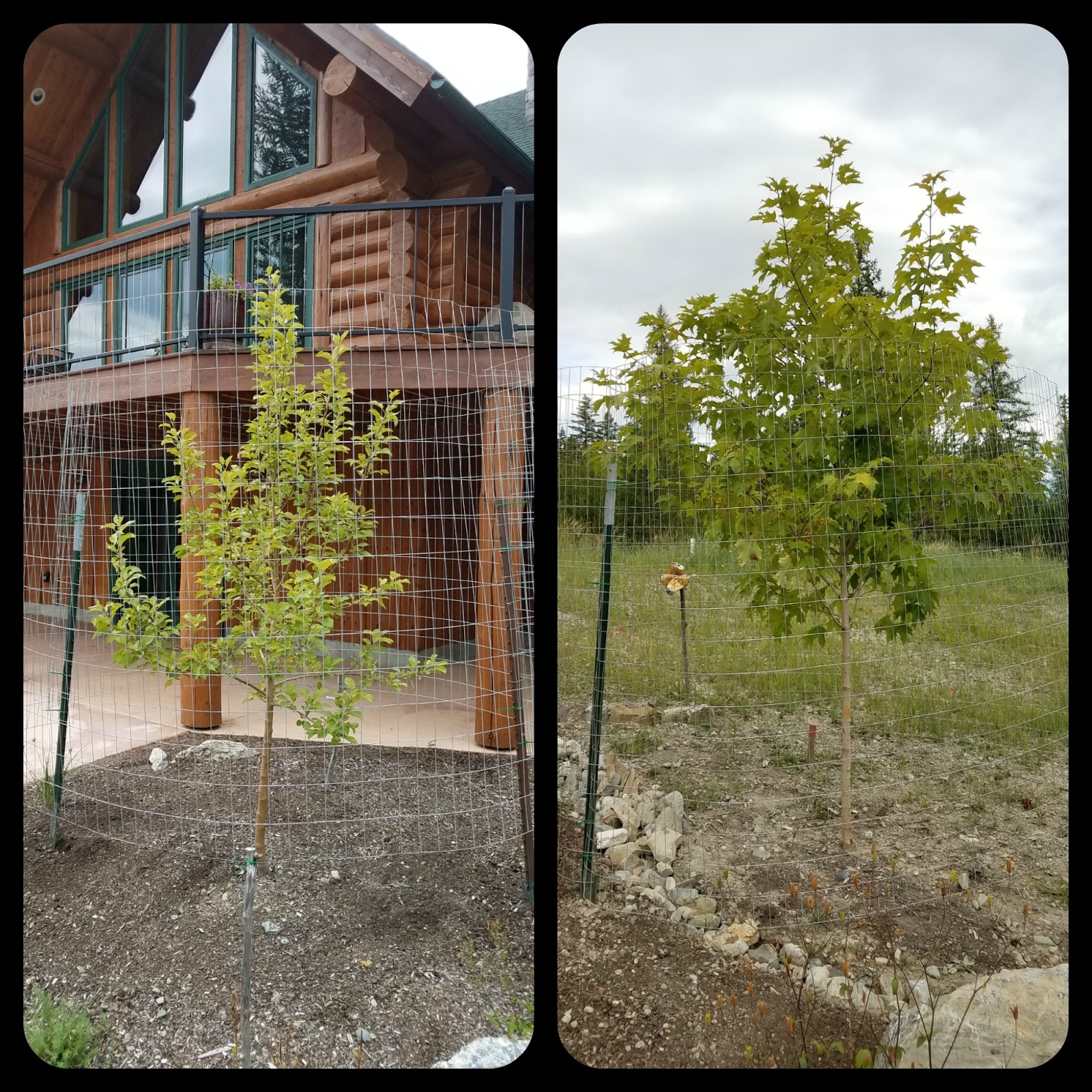
trees.) Not this year, my friends – we bought
taller caging material and put it around both maples and the apple trees.
Soon
we will harvest the apples to prevent them from attracting bears. And frost might nip away at my flower pots as
early as next week. But in the meantime,
I will relish all the beauty that they have to offer.
Welcome to Mosaic Monday, a weekly meme
where we get together to share our photo mosaics and collages.
Please include at least one photo mosaic/collage in your post.
The link will be open from 1 p.m. Sunday until 11 p.m. Monday (U.S. Mountain
time).
Remember to add the link to your Mosaic Monday post and not the one to your
blog.
Please link back to this post so that your readers will be able to visit and
enjoy more wonderful mosaics; taking the MM blog button from my sidebar is an
easy way to link back.
As host I will visit every participant and leave a comment so that you know I
stopped by.
Please try and visit as many other blogs as you can, especially those that join
in later, so that everyone's creativity can be appreciated fully.
Thank you for joining in today and sharing your mosaics with us.


.jpg)

.jpg)

.jpg)
.jpg)


.jpg)


.jpg)
.jpg)