Showing posts with label Dogwood. Show all posts

Sunday, July 12, 2020

Mosaic Monday #88: Glory in the Garden


You knew it was only a matter of time (oops, that was last week's post!) guaranteed that I would wax lyrical about my garden again.  Can you believe it has been 8 weeks since my last garden post?  Muchos cambios, mis amigos, so let's take a look!

Overall, I have been pleased with the outcome of my seed planting (7 out of 13 have come up, and 3 of those were sown in the spring).  54%, barely better than "average", may not seem a palatable result, but, given all of the seeds were hand-collected from last year's garden and that this was my first attempt, I am satisfied.  It has already taught me a thing or two about how thickly (or not) to sow the seeds.  As you can see in some of the pictures below, I could have been a little more judicious.


I sowed Rocky Mountain Bee Plant in multiple locations, and although it came up gangbusters in every one, since then only about half of them are thriving.  Last September, I wrote about these plants, which showed up in our "prairie" on their own.  I collected a bunch of seeds, but left the rest, assuming they would sow themselves.  I have not seen a single one in the prairie.  Go figure!  (In the mosaic above, there must be 20 individual plants in that cluster.)  I am thrilled with the number of columbines that have sprouted, especially since this is a seed sown in the spring.  Given this response, I will focus on seeding columbines rather than trying to transplant little ones.  If you are paying attention (!), you may be asking why there are only six pictures in the mosaic, when I said 7 have sprouted.  Good for you!  


Rocky Mountain Penstemon has also sprouted in half of the locations where it was sowed.  I so admire this hearty plant, and its deep-throated purple flowers, that I am over the moon with this result.  You may also be wondering about the little blue markers you see in the mosaic.  Inquiring minds must be answered!  Three weeks ago, I used these skewer sticks and blue painter’s tape to create little flags denoting sites with emerging plants.  This meant I didn't have to continually reference my seeding plan, and more importantly, prevented me from accidentally "weeding" something I would like to preserve!  (Sometimes, I am not sure, and the flag merits a question mark!!!  I am now pretty confident this is a Rocky Mountain Penstemon - time to update the flag.)

Rocky Mountain Penstemon when it's "all growed up" 


When we first installed our landscaping in 2018, I built a relationship with the Center for Native Plants in Whitefish.  Hailey Moore, the Nursery Manager, has been immensely helpful in a variety of ways – from identifying native and invasive grasses to connecting me with other resources.  In the two years that we have had these sand cherries, I saw significant die-off in the spring.  The first year, I thought it might be “normal”, but I decided not to make any assumptions.  Hailey let me know that Montana State University (Schutter Lab) offers up to five free lab tests per year for Montana residents.  So, per the lab’s instructions, I sent off a healthy sample and a “diseased” sample of the sand cherry.   I also emailed pictures to the lab. 
In less than a week, I had the results from Dr. Eva Grimme: "I suspect that the shrubs are affected by environmental factors like a late frost this spring.  I also found very minor browning/discoloration in the vascular system, which could indicate a fungal canker.  I recommend you check if the branches are still green underneath the bark - this means that they are still alive and may recover.  Prune out the dead branches.  Make sure to sterilize your tools between cuts.  Focus on supporting shrub vigor by providing adequate water and nutrients during the growing season."  As you can see, the pruning was dramatic, but hopefully it will improve the vigor of the shrubs (I have four of them) in the future.  I will also make a note to protect them from frost next spring!
Lower right: after pruning  Other two: "NORMAL"!
If I was self-indulgent, I might be inclined to tell you about EVERY ONE of my plants, but this post would be as long as War and Peace!  A few of them deserve to be called out (and I will, below, but for now, I will let these mosaics speak for the plants.) 

And now for the plants that deserve a special mention.  First up is aspen fleabane.  It has spawned at least 7 volunteers, one as much as 20 feet from the original plant.
 
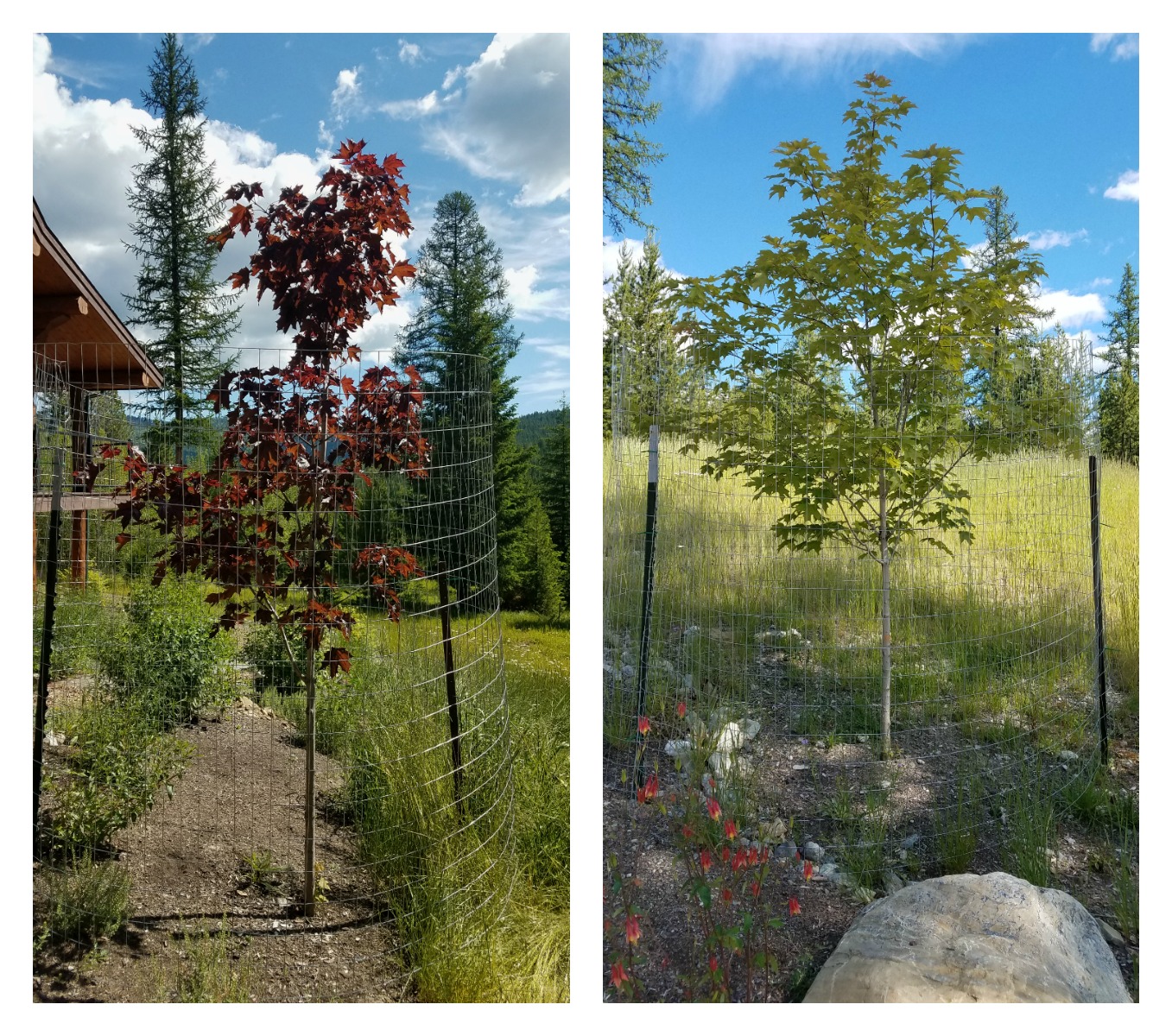
Given my upbringing in the Midwest, the maples are near and dear to me – I already am in love with their shape and can imagine the day when they tower over the house and cast plentiful shade!
The shape of this Catmint is wonderfully symmetrical – a perfect choice on the part of our landscapers for a position next to the flagstone path that leads to the front door.


The scarlet Gilia is a fascinating flower.  When first installed, the three plants appeared as you see in the mosaic below - tall and spindly with flowers scattered along its arch.  The next year, we had many volunteers, but they never rose much above an inch tall.  And this year?  Shazam – blooms all over the place.  It turns out that this two-year cycle is normal for the plant. 


As faithful readers know, we planted wild grass/wildflower seed mix our first fall in the house.  I have been very pleased with the results – many types of grass, flax, poppies, black-eyed susans, coneflower.  And a few lupines.  One of them actually bloomed this year, which is not too bad for only its second year!
Now that my garden is really coming along, “big picture” pictures are more appealing.

Nature continues introducing her own plants to my garden as you can see in the collage below.  I have shown you arnica in the past; this month I have been able to collect seeds and hope that will be another successful experiment next year.
The circular bed around the Douglas Fir in front of the house has been growing so vigorously that my metal moose was getting lost in it.  So, I shifted it and the other decorative lawn art about 5 feet to the left.  Voila!
Doesn't it look like he is chomping on the yarrow?
After an initial slow start, the flower pots on the deck, as well as the flower baskets on the jackleg fence, are thriving.
Of course, my battle with critters is ongoing, from ground squirrels to rabbits to deer.  It was intense for a week or two, including the morning I chased a bunny around the entire house while still in my pajamas!  And then suddenly, no bunny.  Dramatically reduced numbers of ground squirrels.  Maybe the badger family is having an impact!  
The picture at left is the one and only apple blossom we had this spring - no fruit this year.  And don't ask me about the aphid infestation on our golden currants!  


But then I wake up this morning and see this.  Every gardener has her trials, but they all fade into the background when a new bloom erupts in all its glory.  
(I may be slow in commenting due to an overnight camping trip.)


Welcome to Mosaic Monday, a weekly meme where we get together to share our photo mosaics and collages.

Please include at least one photo mosaic/collage in your post.
The link will be open from 1 p.m. Sunday until 11 p.m. Monday (U.S. Mountain time). 
Remember to add the link to your Mosaic Monday post and not the one to your blog. 
Please link back to this post so that your readers will be able to visit and enjoy more wonderful mosaics; taking the MM blog button from my sidebar is an easy way to link back. 
As host I will visit every participant and leave a comment so that you know I stopped by. 
Please try and visit as many other blogs as you can, especially those that join in later, so that everyone's creativity can be appreciated fully. 
Thank you for joining in today and sharing your mosaics with us.  


You are invited to the Inlinkz link party!
Click here to enter

Sunday, September 8, 2019

Mosaic Monday #44: Gardening Galore

Blue flax - from wildflower seed scattered last fall
I have so much to share with you, dear friends.  The ongoing transformation of my garden.  My burgeoning knowledge about the plants in this region.  The challenges of gardening in the woods with critters of all kinds. My embryonic plans for next year’s garden.  Are you seated comfortably?  Then let’s begin.

In my previous garden posts (June 9 and July 21), I have featured 70% of my formal plantings.  Today you will see the remainder, again through collages illustrating their progression since the snow melted!  (Click on the collage to make it bigger.)
I always thought of Goldenrod as "common" - but it has
"grown" on me - LOL!
Bee Balm was in my June 9 post, but before blooming
Coreopsis - in the upper middle photo, the plants are 
barely visible.  They exploded into my most prolific plant,
all by self-seeding.  I transplanted many of them just to
make the flower bed look a little more shapely (lower middle
 shot is "after").  This is also the plant most plagued by deer.
Aster - far right plant was drastically nibbled by deer
earlier this summer - silver lining?  Abundant flowers
on the ends of multiple stems
Prairie coneflower - I love this plant.  Began blooming in
mid-July and is still full of color.   Knock on wood, deer
don't bother it.
Goodland apple - I wrote about the apple trees in my
June 9 post - at that time, they were still in flower.  The
Goodland has 12 apples.  We beefed up the protection on
this tree after the 1 small apple on the Honeycrisp 
disappeared.  Suspect?  Chipmunks.
Scarlet Gilia - given its delicate nature last summer, I was surprised it returned at all.
I have since learned by observation that it does not grow back from its base, but only
by self-seeding - we must have over 140 "volunteers".  I have also learned from visiting
the nursery that it will not flower this year but next.
Russian Sage - another love.  As you can see, it grows back from its base and becomes
this sprawling web of purple.  And the deer don't bother it.
Black-eyed Susan: another plant that returns only via self-seeding.  It takes a keen eye to spot
these "volunteers", and some patience to see how they develop before deciding to keep or
to pluck.  Shortly after the last picture, deer came along and ate this bloom and several of
the buds closest to opening.  Grrrr ….

Speaking of deer – perhaps it is obvious that our “deer defense” system has ceased to be effective.  I guess those clinking beer/cat food cans are now music to their ears!  Few plants have been immune to their affections, but the coreopsis below the mudroom has been nibbled almost every night for the last month.  Good thing I have a lot of it – I have deliberately left some sections uncovered in the hopes that the deer will focus on those.  Friday we installed an “Animal Repeller” – when it senses an animal, it emits a high-pitched noise, and if at night, flashes a strobe light as well.  So far? Mixed results since I do have deer tracks this morning.  Might need to move it slightly.  This has also taught us that we need to change up the defense system.  Cans for a period, then sparkly ribbons, then the repeller, and so on.

Black aphids also returned to the pearly everlasting and the yellow penstemon in mid-August.  The good news?  The Columbian ground squirrels have gone into hibernation!!!  At least one less threat to deal with!

As you can see from some of these pictures, the “formal” landscaping is quickly outgrowing its defined boundaries.  I am torn between a desire for “order”, and the joy of nature doing its thing.  Just given my personality, this will be an ongoing tussle, but I am determined to encourage a natural garden, so “disorder” is the preferred condition.  This means allowing many plants to grow until I can figure out what they are – the benefit is less weeding (at first)!   Each time I realize I have a new volunteer, it’s like a instant shot of joy. 
It is much easier for me to accept “chaos” in our “prairie”, which you may recall was planted with a grass seed/wildflower seed mix last fall.  It’s the gift that keeps on giving – I can almost always find something new out there. 
Clockwise from upper left: Larkspur; Coreopsis variant; Lupine; Purple Coneflower; Blue Flax; Black-eyed Susan
I learned that Blue Flax flowers last less than 24 hours.  I took the above picture in the morning and I was glad I did!

Yarrow
It seems each day brings new learning for me, and from a variety of sources.  Most of it is plain observation.  For example, the aster plant that was significantly pruned by deer produced the most flowers.  And once a plant is flowering, the deer don’t eat it.  And I have been amazed (and pleased) that most of our plants are as advertised – they thrive even in our dry conditions.  Of course, the Web is a superb source of information, but sometimes you need a fellow human, and in that case, the Center for Native Plants has been a god-send.    While the wildflowers have been easy to identify, the grasses have been much more difficult.

I called Hooper’s Garden Center (which provided the grass/wildflower mix), and they gave me a list of grasses that was included in the mix.  I studied each of them, even sketching diagrams in my garden journal, and teaching myself about grass anatomy.  Unfortunately, most of them did not seem to match the grasses outside.  I reached out to a friend who works for the Forest Service, and he recommended two sources: the book “Plants of the Rocky Mountains” and the Center for Native Plants in Whitefish. 

I ordered the book and it was helpful to identify some of the grasses, but I still had gaps.  So, on one of my weekly trips to Whitefish, I stopped in the Center and talked with Sarah about my challenge.  She referred me to the nursery manager, Hailey.  She suggested Hailey might come out to our house (for a fee plus gas), but that she might also be able to identify the grasses just from pictures.  Sold!  That night I sent off a series of emails to Hailey, and within a few days she had responded.  Most importantly, she was able to tell me that only one of the grasses is highly invasive. 
Lower middle is Cheatgrass - highly invasive.  Fortunately, I only found two small patches of it - pulled it up
carefully - trying not to spread seeds - and threw it away.  Only three of these matched the list given to me
by Hooper's.  Go figure!

While I am enjoying the plants which are blooming in the garden now, half of me has already turned my attention to next year’s garden.  At the end of July, seeds were ready to be harvested from both columbine and blanket flower plants.  Since then, I have also collected the following seeds: aspen fleabane, lupine, chives, goldenrod, nodding onion, aster, coreopsis, rocky mountain penstemon, red poppy, bee balm, coneflower and yarrow.  It gave me great joy yesterday to give some seeds to a friend who recently moved into her new house.
At least half of my seeds are to be planted in the fall, so I am creating to-scale drawings of each of my flower beds, including all the volunteers.  This will allow me to decide where to augment the landscape, taking into account size, color and the time frame for blooming.  I would like to make sure that every flower bed has something in bloom at all times.

Red Osier Dogwood
In early August, we transformed the area near our “address rock”.  Our neighbor on the hill had previously given us nearly 20 rocks, and had carefully arranged them in a semi-circle using his tractor.  After driving by it numerous times, I decided for a different look, and he willingly came down the hill with the tractor and re-arranged them in real time.  And gave us a scoop of dirt.  And dug a hole for a dogwood we plan to place there.  What a pal!  The barter system is alive and well in Montana; he was happy to help us out in exchange for the water he has been able to access from our well head throughout the summer! 

We will be adding some top soil to the area, and then fall seeding will begin using the design you see below.  The Red Osier Dogwood will go in the hole – it is meant to provide some contrast with the pines, and to anchor that end of the flower bed.  A few transplants, such as juniper, will complete the fall planting and we will let Mother Nature do her work until it is time for spring planting of the other seeds.  I am so excited to see how this develops.

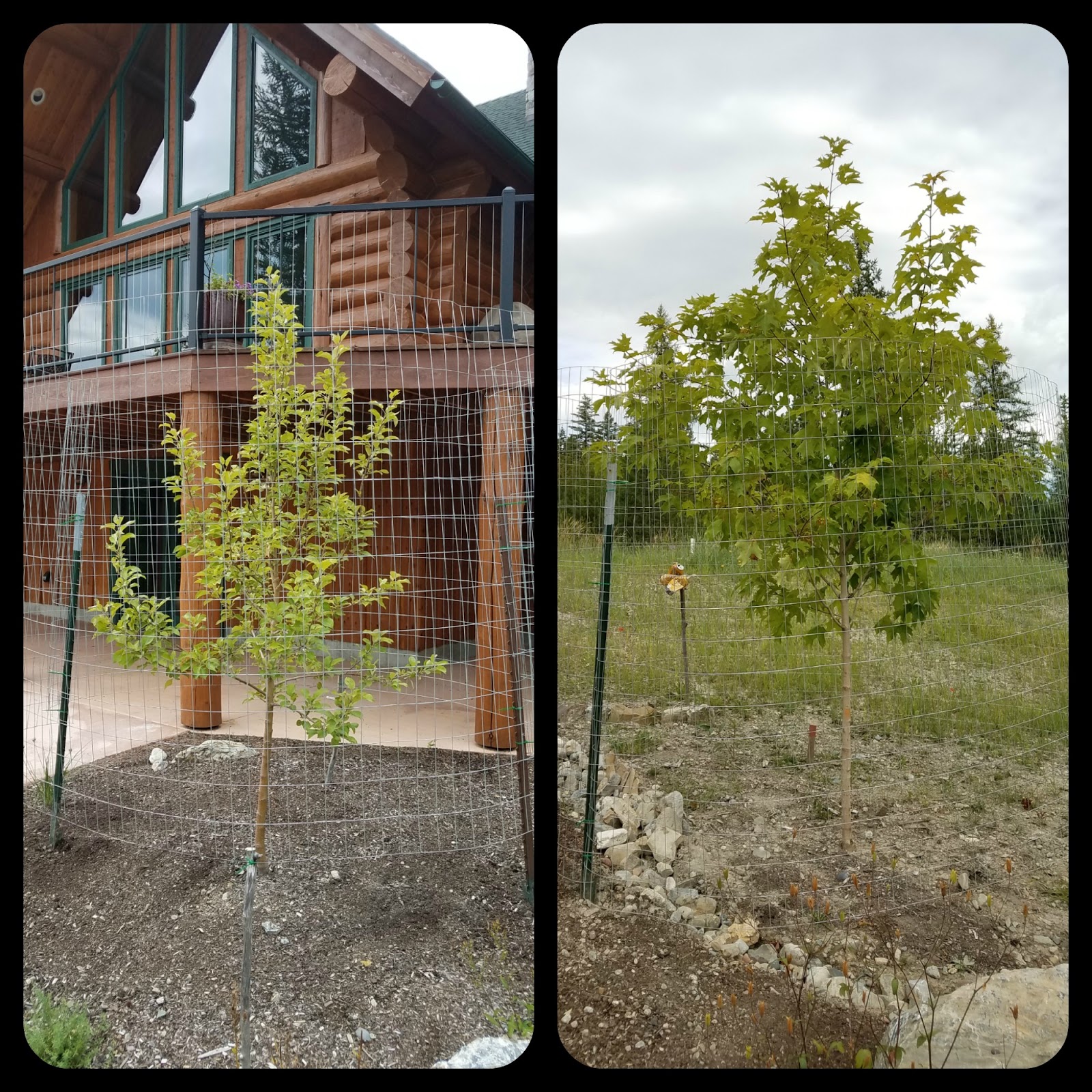
Re-focusing on events closer on the time horizon, I wanted to get a jump on the deer and/or the elk that might take a shine to the apple trees and maples. (You may remember my post from September 29 last year, when elk had seriously pruned one of my maples and also nibbled the apple trees.)  Not this year, my friends – we bought taller caging material and put it around both maples and the apple trees. 
Soon we will harvest the apples to prevent them from attracting bears.  And frost might nip away at my flower pots as early as next week.  But in the meantime, I will relish all the beauty that they have to offer.  


Welcome to Mosaic Monday, a weekly meme where we get together to share our photo mosaics and collages.
Please include at least one photo mosaic/collage in your post.
The link will be open from 1 p.m. Sunday until 11 p.m. Monday (U.S. Mountain time).
Remember to add the link to your Mosaic Monday post and not the one to your blog.
Please link back to this post so that your readers will be able to visit and enjoy more wonderful mosaics; taking the MM blog button from my sidebar is an easy way to link back.
As host I will visit every participant and leave a comment so that you know I stopped by.
Please try and visit as many other blogs as you can, especially those that join in later, so that everyone's creativity can be appreciated fully.
Thank you for joining in today and sharing your mosaics with us.
 
You are invited to the Inlinkz link party!
Click here to enter
Related Posts Plugin for WordPress, Blogger...