Showing posts with label Strawberry. Show all posts

Sunday, July 12, 2020

Mosaic Monday #88: Glory in the Garden


You knew it was only a matter of time (oops, that was last week's post!) guaranteed that I would wax lyrical about my garden again.  Can you believe it has been 8 weeks since my last garden post?  Muchos cambios, mis amigos, so let's take a look!

Overall, I have been pleased with the outcome of my seed planting (7 out of 13 have come up, and 3 of those were sown in the spring).  54%, barely better than "average", may not seem a palatable result, but, given all of the seeds were hand-collected from last year's garden and that this was my first attempt, I am satisfied.  It has already taught me a thing or two about how thickly (or not) to sow the seeds.  As you can see in some of the pictures below, I could have been a little more judicious.


I sowed Rocky Mountain Bee Plant in multiple locations, and although it came up gangbusters in every one, since then only about half of them are thriving.  Last September, I wrote about these plants, which showed up in our "prairie" on their own.  I collected a bunch of seeds, but left the rest, assuming they would sow themselves.  I have not seen a single one in the prairie.  Go figure!  (In the mosaic above, there must be 20 individual plants in that cluster.)  I am thrilled with the number of columbines that have sprouted, especially since this is a seed sown in the spring.  Given this response, I will focus on seeding columbines rather than trying to transplant little ones.  If you are paying attention (!), you may be asking why there are only six pictures in the mosaic, when I said 7 have sprouted.  Good for you!  


Rocky Mountain Penstemon has also sprouted in half of the locations where it was sowed.  I so admire this hearty plant, and its deep-throated purple flowers, that I am over the moon with this result.  You may also be wondering about the little blue markers you see in the mosaic.  Inquiring minds must be answered!  Three weeks ago, I used these skewer sticks and blue painter’s tape to create little flags denoting sites with emerging plants.  This meant I didn't have to continually reference my seeding plan, and more importantly, prevented me from accidentally "weeding" something I would like to preserve!  (Sometimes, I am not sure, and the flag merits a question mark!!!  I am now pretty confident this is a Rocky Mountain Penstemon - time to update the flag.)

Rocky Mountain Penstemon when it's "all growed up" 


When we first installed our landscaping in 2018, I built a relationship with the Center for Native Plants in Whitefish.  Hailey Moore, the Nursery Manager, has been immensely helpful in a variety of ways – from identifying native and invasive grasses to connecting me with other resources.  In the two years that we have had these sand cherries, I saw significant die-off in the spring.  The first year, I thought it might be “normal”, but I decided not to make any assumptions.  Hailey let me know that Montana State University (Schutter Lab) offers up to five free lab tests per year for Montana residents.  So, per the lab’s instructions, I sent off a healthy sample and a “diseased” sample of the sand cherry.   I also emailed pictures to the lab. 
In less than a week, I had the results from Dr. Eva Grimme: "I suspect that the shrubs are affected by environmental factors like a late frost this spring.  I also found very minor browning/discoloration in the vascular system, which could indicate a fungal canker.  I recommend you check if the branches are still green underneath the bark - this means that they are still alive and may recover.  Prune out the dead branches.  Make sure to sterilize your tools between cuts.  Focus on supporting shrub vigor by providing adequate water and nutrients during the growing season."  As you can see, the pruning was dramatic, but hopefully it will improve the vigor of the shrubs (I have four of them) in the future.  I will also make a note to protect them from frost next spring!
Lower right: after pruning  Other two: "NORMAL"!
If I was self-indulgent, I might be inclined to tell you about EVERY ONE of my plants, but this post would be as long as War and Peace!  A few of them deserve to be called out (and I will, below, but for now, I will let these mosaics speak for the plants.) 

And now for the plants that deserve a special mention.  First up is aspen fleabane.  It has spawned at least 7 volunteers, one as much as 20 feet from the original plant.
 
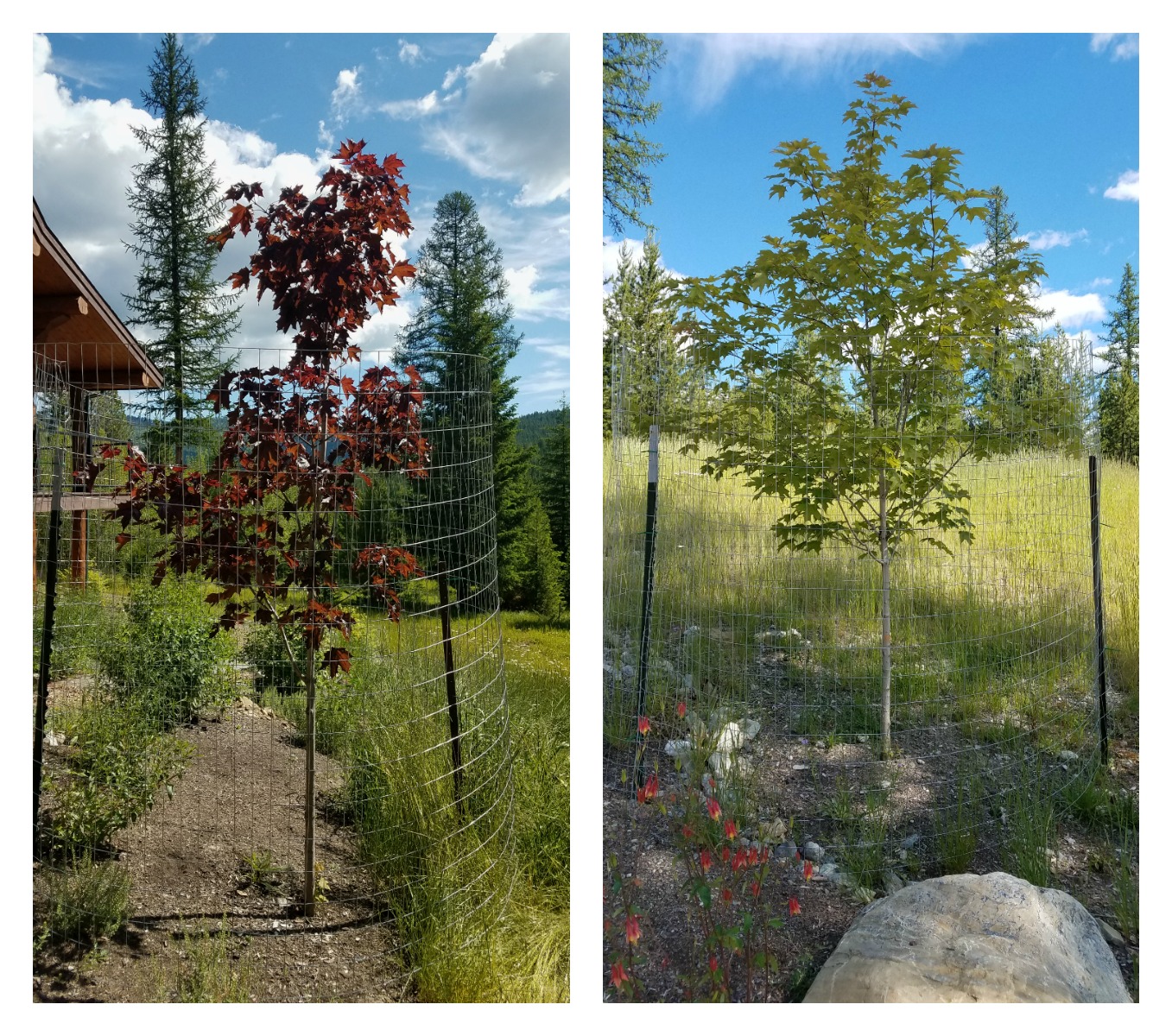
Given my upbringing in the Midwest, the maples are near and dear to me – I already am in love with their shape and can imagine the day when they tower over the house and cast plentiful shade!
The shape of this Catmint is wonderfully symmetrical – a perfect choice on the part of our landscapers for a position next to the flagstone path that leads to the front door.


The scarlet Gilia is a fascinating flower.  When first installed, the three plants appeared as you see in the mosaic below - tall and spindly with flowers scattered along its arch.  The next year, we had many volunteers, but they never rose much above an inch tall.  And this year?  Shazam – blooms all over the place.  It turns out that this two-year cycle is normal for the plant. 


As faithful readers know, we planted wild grass/wildflower seed mix our first fall in the house.  I have been very pleased with the results – many types of grass, flax, poppies, black-eyed susans, coneflower.  And a few lupines.  One of them actually bloomed this year, which is not too bad for only its second year!
Now that my garden is really coming along, “big picture” pictures are more appealing.

Nature continues introducing her own plants to my garden as you can see in the collage below.  I have shown you arnica in the past; this month I have been able to collect seeds and hope that will be another successful experiment next year.
The circular bed around the Douglas Fir in front of the house has been growing so vigorously that my metal moose was getting lost in it.  So, I shifted it and the other decorative lawn art about 5 feet to the left.  Voila!
Doesn't it look like he is chomping on the yarrow?
After an initial slow start, the flower pots on the deck, as well as the flower baskets on the jackleg fence, are thriving.
Of course, my battle with critters is ongoing, from ground squirrels to rabbits to deer.  It was intense for a week or two, including the morning I chased a bunny around the entire house while still in my pajamas!  And then suddenly, no bunny.  Dramatically reduced numbers of ground squirrels.  Maybe the badger family is having an impact!  
The picture at left is the one and only apple blossom we had this spring - no fruit this year.  And don't ask me about the aphid infestation on our golden currants!  


But then I wake up this morning and see this.  Every gardener has her trials, but they all fade into the background when a new bloom erupts in all its glory.  
(I may be slow in commenting due to an overnight camping trip.)


Welcome to Mosaic Monday, a weekly meme where we get together to share our photo mosaics and collages.

Please include at least one photo mosaic/collage in your post.
The link will be open from 1 p.m. Sunday until 11 p.m. Monday (U.S. Mountain time). 
Remember to add the link to your Mosaic Monday post and not the one to your blog. 
Please link back to this post so that your readers will be able to visit and enjoy more wonderful mosaics; taking the MM blog button from my sidebar is an easy way to link back. 
As host I will visit every participant and leave a comment so that you know I stopped by. 
Please try and visit as many other blogs as you can, especially those that join in later, so that everyone's creativity can be appreciated fully. 
Thank you for joining in today and sharing your mosaics with us.  


You are invited to the Inlinkz link party!
Click here to enter

Sunday, May 24, 2020

MM #81: Learning My Lessons (or a Garden Tour with Dad)

Golden Currant - May 23, 2020
Nature has a way of teaching us.  Such as: don't plant your pots before the end of May!  You would think I would know better, having lived in Montana for three years.  But sometimes the heart outpaces the head!!!

As faithful readers know, I even started a garden journal last year (see June 9, 2019, July 21, 2019, and September 8, 2019), to document my learning and for other reasons.  Sigh.  But not all is doomed - I have good news as well, and some of it even derived from my knowledge gained last year.

And how can I be downcast when I am IN MY GARDEN?  It is a joy that vibrates through my whole being, and hard to explain to any but other gardeners.  If I am ever somewhat morose, it is when I think of my Dad, and how I would thrill to give him a garden tour, as he was wont to do with all family, and anyone else that he could swindle into it!  So, you will be patient with me in this post, as I act out a garden exploration with my Dad.

May 7, 2020
Let us begin at the driveway entrance.  In May 2019, we built jackleg fences to mark the driveway,  and the next month we added flower baskets to sections of the fence using chicken wire and coconut fiber.  This year, we added a layer of black plastic between the fiber and the soil to aid moisture retention.  In hindsight, we should have poked some holes through the plastic to allow for some drainage.  After several days of steady rain, I feared the whole structure might break under the weight, and I found myself out there trying to punch holes from beneath with a screwdriver.  Marginally successful.  Also, we planted too soon- on May 13, Spousal Unit helped me rig temporary covers from clothes hangers and trash bags since frost was in the forecast.  It did the trick, but what a pain!!!
I'm talking about flowers, and I can envision my Dad sizing up
trees, hands on hips, shrewdly observing that two of our
larch transplants don't look healthy.
Rocky Mountain Bee Plant - May 23, 2020
In August 2019, our-neighbor-with-a-digger helped us construct the flower bed near our "address rock".  As I wrote in this post, fall transplanting included the red osier dogwood, juniper, pearly everlasting and Russian sage.  All have survived the winter except for the sage.  In the fall, I also planted coneflower, goldenrod, rocky mountain bee plant, aster, aspen fleabane and grass seed.  In the spring, I sowed blanket flower, columbine and yarrow.  Thus far, I can clearly identify the bee plant, first based on location; now I can discern the plant by its leaves.  Coneflowers may also be sprouting, but it will take a few more weeks to be sure.  On a whim, I also threw some sunflowers by rocks on the other side of the driveway, and they have emerged!

Transplanted lupine - May 20, 2020
As we stroll up the driveway, I cannot spot any of the lupines that I sowed in the fall.  It doesn't help that I didn't mark my planting spots!  Such a mistake - WHAT was I thinking?  If Dad was here, I would take the opportunity to reminisce about planting beans (or was it peas?)  Back in the day, Dad coated them with some black stuff, and then us kids would poke them into the ground.  With the benefit of age and learning about planting lupine seeds, I realize the "black stuff" was an inoculant - I performed the same operation when sowing my lupines in the fall.  Maybe they will still grow, but I am skeptical given that other lupines in the area are well underway.  In fact, my kind Dear Neighbor Friend took me to a nearby ridge and we harvested 29 lupines of varying sizes, which were transplanted along the driveway.  Some sources say lupines don't tolerate root disturbance, but it is an experiment.  So far, 5 are perky, 7 are middlin' and the remainder look downright dead.  Time will tell.

Columbine volunteers: May 23, 2020
Arriving at the flagstone path to the front door, we begin to see the "formal" landscaping installed in June 2018.  I have been very pleased that some of the plants are propagating nicely.  Case in point: the columbines.  In this area alone, I have 6 "volunteers".  Second example: the goldenrod.  Too many "babies" to count.  It does appear that the seeds do best when they have something to grip to, like gravel.  Perhaps otherwise, they simply blow away.  In many cases, the instruction is to sow "on the surface:.  Well, there you go.  And THERE they go!  So I think I will, in future, try sowing this type of seed among some gravel, which can later be removed.
Goldenrod nursery - April 26 - May 23, 2020
Ah, the pot on the front porch (and the other pots, too, for that matter).  A sad story.  Clearly, planted too soon on May 10.  The coleus have already withered away, and the black susan vines are not faring much better.  Just one too many nights with cool temps and days with light snow that didn't stick.  Lesson learned!
Pots on May 10 - and no, I am not going to show you how they look now
By the way, we do think Spring has been later and cooler than last year.  As "evidence", ladies and gentlemen of the jury, I submit the following comparisons.
Columbine
Left:  May 21, 2019 (flowers forming)                   Right: May 23, 2020
Goodland Apple
Left: May 21, 2019                                                                  Right: May 23, 2020
Norway Maple
Left:  May 21, 2019                                               Right: May 23, 2020
Some sections of the "formal" landscaping still look orderly, with rounded clumps of plants at regular intervals.  Other areas are starting to fill in, randomly, and in the manner I have envisioned.  As I gaze upon some higgledy-piggledy areas in my flower beds, I wonder what Dad might say.  I remember him as a perfectionist when it came to his lawn, trees and vegetable garden, although he would clearly tolerate a volunteer tomato or two.  I don't recall much in the way of flowers, so I wonder.

In its "final" stages, I hope for a prairie, awash with a variety of plants and bushes, growing together in a riot.  This means a few things: 1) I have to be patient, and let a plant grow for a while in order to determine if it belongs, 2) it is harder to decide if something has been nibbled, and 3) since I have more plants, I don't freak out as much if ONE is nibbled!


Oil Beetle is distinguished from other Blister Beetles by its short wings
I have discovered a new "enemy", the Oil Beetle.  Weeding one day, I noticed this prehistoric-looking creature eating a plant.  What?  I took a picture, squished it with a stick and then looked it up.  An Oil Beetle may seem an ordinary black bug, but its secret weapon (a caustic chemical called cantharidin) can blister human skin.  It is part of a family of Blister Beetles, which are fond of flowers, nectar and plant juices.  I see them frequently now, and if they are on one of my ornamental plants, they are DEAD.  This creature might explain "nibbling" that has happened in the past when plants were caged.  Below is an aster that has been stripped of its leaves.  I think I know the culprit!


Dad had an arsenal of bug-fighting tools at his disposal, and the one that stands out in my memory was a knee-high metal canister with an attached tube and nozzle.  It had a pump handle, and its main use was to spray the fruit trees.  I also remember Sevin being applied liberally to chase off aphids, and it was easy to turn to that last year when I had an infestation.  But sometimes, no tool or product was necessary.  Give him a cutworm on a prize tomato plant, and he would grab it and PINCH, it would be oozing green caterpillar juice on his fingers.  I surmise that's why I reacted without thinking when I saw that beetle munching its way through my plant! 

As we pass around the side of the house, and take the stone steps down to the "back yard", I am sure my Dad would be looking at the grass and wondering when we will get out the mower.  In the fall of 2018, we sowed 50 pounds of wild grass seed, combined with wildflower seed.  Last fall, we added top soil to the remaining barren areas, and I scattered grass seed that I had painstakingly gathered by hand.  As you can see in the comparison pictures, we have progressed from construction zone to "I am thinking about being a prairie."  Spousal Unit has suggested that we buy more grass seed this fall to save my collecting it, and I am on board for that!
Top: area near fire pit - May 21, 2019
Bottom: same location - May 22, 2020
May 23, 2020 - Penstemon and Coreopsis
Actually, I think Dad would understand that my dream for my garden and "yard" is different than his.  Dad had his favorites, his "pride and joy," in his garden.  I am no different.  The "apple" has not fallen far from the tree.  Anything that is blooming, gives me joy.  I am thrilled that plants are settling into the rocky areas, lending a natural, "we've always been here" look to our stone steps.  I am excited about plants that gave me fits last summer, only to come roaring back this spring.  
I took care to guard the strawberries, since they were some of the
first plants to be nibbled last year.  They are thriving.
Top - yellow penstemon original plant
Bottom right and left: "volunteers" - amazing when you consider the mama plant was afflicted with aphids!
And as the boundary between the "formal" and the "woods" begins to blur, I have a growing appreciation for the naturally occurring plants in this region.  They were here first, and I welcome them to mix and mingle and make my dream come true.


Welcome to Mosaic Monday, a weekly meme where we get together to share our photo mosaics and collages.
Please include at least one photo mosaic/collage in your post.
The link will be open from 1 p.m. Sunday until 11 p.m. Monday (U.S. Mountain time).
Remember to add the link to your Mosaic Monday post and not the one to your blog.
Please link back to this post so that your readers will be able to visit and enjoy more wonderful mosaics; taking the MM blog button from my sidebar is an easy way to link back.
As host I will visit every participant and leave a comment so that you know I stopped by.
Please try and visit as many other blogs as you can, especially those that join in later, so that everyone's creativity can be appreciated fully.
Thank you for joining in today and sharing your mosaics with us.
 
You are invited to the Inlinkz link party!
Click here to enter

Sunday, June 9, 2019

Mosaic Monday #31 - How Does Your Garden Grow?

Blue Columbine
My April 14 post, Anticipation, had me dreaming about the wild grass and wildflowers that we sowed in the fall.  I also speculated about our formal landscaping - would it return?  Would there be self-seeding?  Would the apple trees bloom and cross-pollinate?  And then we have the pines and the aspens we transplanted at the end of the summer.  Did they survive?  Since I know you have all been on the edge of your seats waiting for the answers, this post will put your inquiring minds to rest.


I began keeping a garden journal on April 21; on a weekly basis, I note observations about each of the plants, and take pictures.  I am also tracking key events such as rainfall.  I am confident that in years to come, my notes will become my own mini-Farmer's Almanac for planning purposes.  Call me crazy, but this approach and its future application gets me jazzed!


If I went all-out with this post, it would contain over 25 mosaics to document plant progress since April.  This is good news because it means that most of the landscaping survived the winter, but even I think that's too much.  Perhaps I will focus on the most dramatic transformation, or my favorite plants.  Let's start and see where this goes.

BEE BALM: I am excited to have several of these plants in our garden since they are a magnet for bees, butterflies and hummingbirds.  Last year, they did not bloom; I am hoping the second year in the ground will make a difference.
Left to right: April 21 through June 2; all other collages will follow
a similar format
COLUMBINE: My love affair with this flower began when I saw a plethora of yellow columbine along the Highline Trail in Glacier National Park.  Our garden contains red and blue columbine, although some of the flowers seem to vary from what was on the official tag.  Never mind, they are delicate and unique and I never tire of looking at them.
Red Columbine

WILD STRAWBERRY: You might be surprised to know that wild strawberry flourish in this mountain climate; the plant is among the first to sprout and bloom.  Of course, this also means they are very attractive to hungry critters in the spring.  This plant was chowed down to the ground at the end of April, and has been nibbled at least once since then while making a comeback.

PAINTBRUSH: If you've never seen one of these, the pictures will soon reveal the source of its name.  Paintbrush is a sought-after prairie beauty that prefers bright sites with medium dry soils.  Its vivid bracts nearly hide small greenish flowers.  These plants are seldom grown in gardens because they are partly parasitic and require the roots of a host plant to survive.

GOLDEN CURRANT: an ornamental shrub with fragrant, yellow trumpet flowers, this drought tolerant plant should produce sweet, golden seedy fruit within three years of planting.  Given the maturity of these shrubs when they were planted last summer, fruit this year is a distinct possibility.
The currants were the first of our shrubs to leaf out

WESTERN SAND CHERRY: This small shrub has grayish-green leaves that turn purple in the fall.  The mass of white flowers along the branches in the spring are followed by large quantities of purple-black fruits in summer.  Unfortunately, as you can see in the upper middle photo of the collage below, a couple of the sand cherries show significant withering.  I discussed it with our landscaper, and he asked if aphids were present.  By the time the damage was visible, if it was aphids, they had moved on.  I suspect it was aphids since I have now discovered the little sap suckers on our burning bushes!

WILD GRASS/WILDFLOWER SEED: Last fall, we scattered 30 pounds worth of wild grass seed, mixed with wildflower seed.  We were equal parts hopeful and skeptical, given 1) the seed is sown in soil that has been scored to loosen it - so, essentially, the seed is lying on top of the soil, 2) the target areas were disturbed and in some cases compacted during construction, and 3) birds and other critters would have an opportunity before snow fall and after snow melt to gobble up the seed.  I am pleased to report that hopeful won out in this case - we have a healthy crop of grass (that we don't have to mow) - the wildflowers will take a little longer to see.

TRANSPLANTS: In my November 7, 2018 post, I wrote that we had transplanted no less than 2 juniper, 18 aspen, 5 Engelmann spruce, 2 Douglas fir and 9 larches.  As spring approached, I recalled my days as a pregnant woman - anxiety mixed with joy as I anticipated our success rate.  AND?  The spruce and the fir are not showing new growth, but the needles feel soft, which means they are still alive.  (A dead tree would drop its needles at the merest touch, much like a dried-out Christmas tree.) The juniper have green tips, and 17 out of 18 of the aspen have leaves, with most of them fully leafed out.  I cannot say we have enjoyed such a ratio with the larch - only 4 out of the 9 greened up, and one more is questionable.  Sigh.  Good thing we have plenty of young larch to draw from elsewhere on our property when we try again in the fall!
Upper left: aspen; lower left: juniper
Top and bottom right: larch

ROYAL RED NORWAY MAPLE: If you've been following my blog for a while, you will recall that this maple was subject to some severe "pruning" by elk last fall.  It's still a little lopsided, but the overall condition is better than I expected when the elk left it with little more than a "poodle tail"!

FALL FIESTA SUGAR MAPLE: Now, this is a tree!  You can take the girl out of the Midwest, but you can't take the Midwest out of the girl!  Something about the leaf shape, the contour of the tree, its fullness - ah, that's a tree!

APPLE TREES: I saved the best for last!  The Honeycrisp was planted to honor my Father, a life-long gardener who taught me most of what I know about nurturing a landscape (he passed away in April 1998).  When I was a young girl, we had Winesap and Golden Delicious trees - so many sweet memories are tied to that small orchard.

As it turns out, a Honeycrisp needs another apple tree for pollination, so it seemed only fitting to dedicate the second tree, a Goodland, to my Mother.  It was a blessing that my Mom was here last September to harvest the first apples from her tree.  As I watch the bees and other pollinators buzz about the blossoms, I think of my parents, and I wish my Dad could have been here for one of his famous "garden tours", only this time I would be giving the tour.  This post is for you, Dad!
Elk also "pruned" the Goodland but it has made a full recovery

Welcome to Mosaic Monday, a weekly meme where we get together to share our photo mosaics and collages.
Please include at least one photo mosaic/collage in your post.
The link will be open from 1 p.m. Sunday until 11 p.m. Monday (U.S. Mountain time).
Remember to add the link to your Mosaic Monday post and not the one to your blog.
Please link back to this post so that your readers will be able to visit and enjoy more wonderful mosaics; taking the MM blog button from my sidebar is an easy way to link back.
As host I will visit every participant and leave a comment so that you know I stopped by.
Please try and visit as many other blogs as you can, especially those that join in later, so that everyone's creativity can be appreciated fully.
Thank you for joining in today and sharing your mosaics with us.


You are invited to the Inlinkz link party!
Click here to enter
Related Posts Plugin for WordPress, Blogger...