Showing posts with label Sand cherry. Show all posts

Sunday, June 13, 2021

Mosaic Monday #135: Going Native

I was raised by a lawn and garden perfectionist.  Nary a dandelion to be found in my Dad's rolling Zoysia landscape.   Trees were pruned to showcase the natural architecture of the branches - my Dad's sculptures were as beautiful in the winter as they were when wearing a full coat of leaves.   His vegetable garden was just as meticulous, with ruler-straight rows and cages to keep those tomatoes in line.

Until we moved to our current home in Montana, I strived to be that gardener.

With the new construction associated with our log home, the landscape immediately around the house was a blank canvas.  In the process of making other design choices, I must have thumbed through a hundred Log Home Living magazines.  In most cases, the curb appeal of the featured homes was classic - manicured lawns, rock gardens with showy trees, and lakeside settings with trellises and gazebos.  As tempting as it was, Spousal Unit and I knew that this was not the answer for us.  

Retirement is to be enjoyed, right?  So, for a start, Spousal Unit declared that his last lawnmower would not be coming with us.  OK.  Check.  No formal lawn.  

As for me, I would also want freedom in the summers for hiking, camping, kayaking -- well, you get the point.  So, something low maintenance was in order.

Ever since we lived in Arizona, I have had an aversion to sprinkler systems.  If one is needed regularly, it means the plants in the landscape are not native, not adapted to the rainfall that is normal for the area.  That was it -- I wanted to go native.

"Water, water, water ... There is no shortage of water in the desert but exactly the right amount, a perfect ration of water to rock, water to sand, insuring that wide free open, generous space among plants and animals, homes and towns and cities, which makes the arid West so different from any other part of the nation.  There is no lack of water here unless you try to establish a city where no city should be."  -- Edward Abbey

We are three years into this gardening adventure, and I am still learning.  Recently, I had the opportunity to attend a webinar entitled "Conservation Gardening: Landscaping with Montana Native Plants for Montana's Native Wildlife."  Led by David Schmetterling, the webinar covered how to landscape with resource conservation, drought and wildlife in mind.  His "laboratory" was a small city lot around his Missoula, Montana home.

I was enlightened.  Going native is not just about the plants, but the entire ecosystem.  Yes, even the insects, even those who want to eat my plants.  He shared a story about paper wasps who score the bark of aspens to make their large paper nests.   Aspen beetles use the scars to lay eggs.  In the spring, as larvae hatch, ants are there to eat some of them.  The tree responds to the scar by oozing sap, an early food source for butterflies before flowers are blooming.  In other words, if I eradicated the paper wasps, I would impact three or more other species!!!

I resolved to look at my garden differently this spring.  Insects on native plants would be left to their devices.  Infestations on non-natives would be addressed. 

Fairly quickly, I had an opportunity to test myself.  On May 31, I observed some irregularity on the goldenrod, and closer inspection revealed this black and white caterpillar. (I put it on the rock only to get a photo.)  You would be so proud of me - I left it there on the rock!  Of course, anything living has to have a name, so I embarked into the world of caterpillar identification.  Thirty minutes later, I was none the wiser.  It could be an asteroid, the brown-hooded owlet, the camouflaged looper, the common pug, the striped garden caterpillar or the goldenrod gall moth.  Didn't look like any of them!  Spousal Unit suggested I give it a name, so Montanas Angelas it is!

By June 8, I had already lost my resolve, partly because Spousal Unit expressed a concern that the goldenrod would not flower properly.  A few caterpillars were sacrificed, but I didn't touch the few aphids that I found on the goldenrod, or the spittlebugs with their cocoons of spit.

I can take some consolation in my approach to the golden currants -- I did not spray the aphids that massed on the fresh growth on May 31.  And now I can report that the aphids are gone, with no apparent damage.  Lesson learned!


I have written extensively in the past about my attempts to deter the deer and other critters.  I believe I have finally found an effective solution.  This sprinkler features a built-in motion detector, which prompts it to go off suddenly with two full arcs.  I know it frightens me when I forget it's there and I wander into range!  Four have been placed in strategic locations, and the deer no longer come into the main section of the landscaping.  Of course, nothing is foolproof - a female turkey did a number on several of my chive plants by walking in between the sprinklers,  C'est la vie - I'll take it!


Ever since the first time I saw lupines in bloom, I have been longing to have them on my property.  Last May, Dear Neighbor Friend and I transplanted 27 lupines.  As the summer wore on, they all seemed to die.  It was a long shot -- everything I read indicated that lupine don't like their roots to be disturbed.  So, I bought some lupine seeds, and planted them in over 35 spots around the garden.  I have been so pleased with the results - all but four spots sprouted one or more lupine.  AND, as I have been making my rounds, I have discovered that some of the transplants have grown as well!!!

From this seed-planting experience, I have also learned that it doesn't take much magic to get results.  I tossed (literally) some seeds behind our jack-leg fence, and in an open area to the left of the fire pit.  Both areas have yielded a bumper crop of baby lupines!!! They are tiny now, but in years to come, they will put on a majestic spring show!


With the benefit of hindsight, I might wish that I had not agreed to include non-natives in the landscaping.  For example, the sand cherries have suffered die-back every spring.  Last year, I carefully clipped a "diseased" portion and engaged Montana State University.  The experts there advised pruning and sanitizing the shears after each clip.  Well, here we are again with die-back.  This year, I am going to leave it and see what happens.


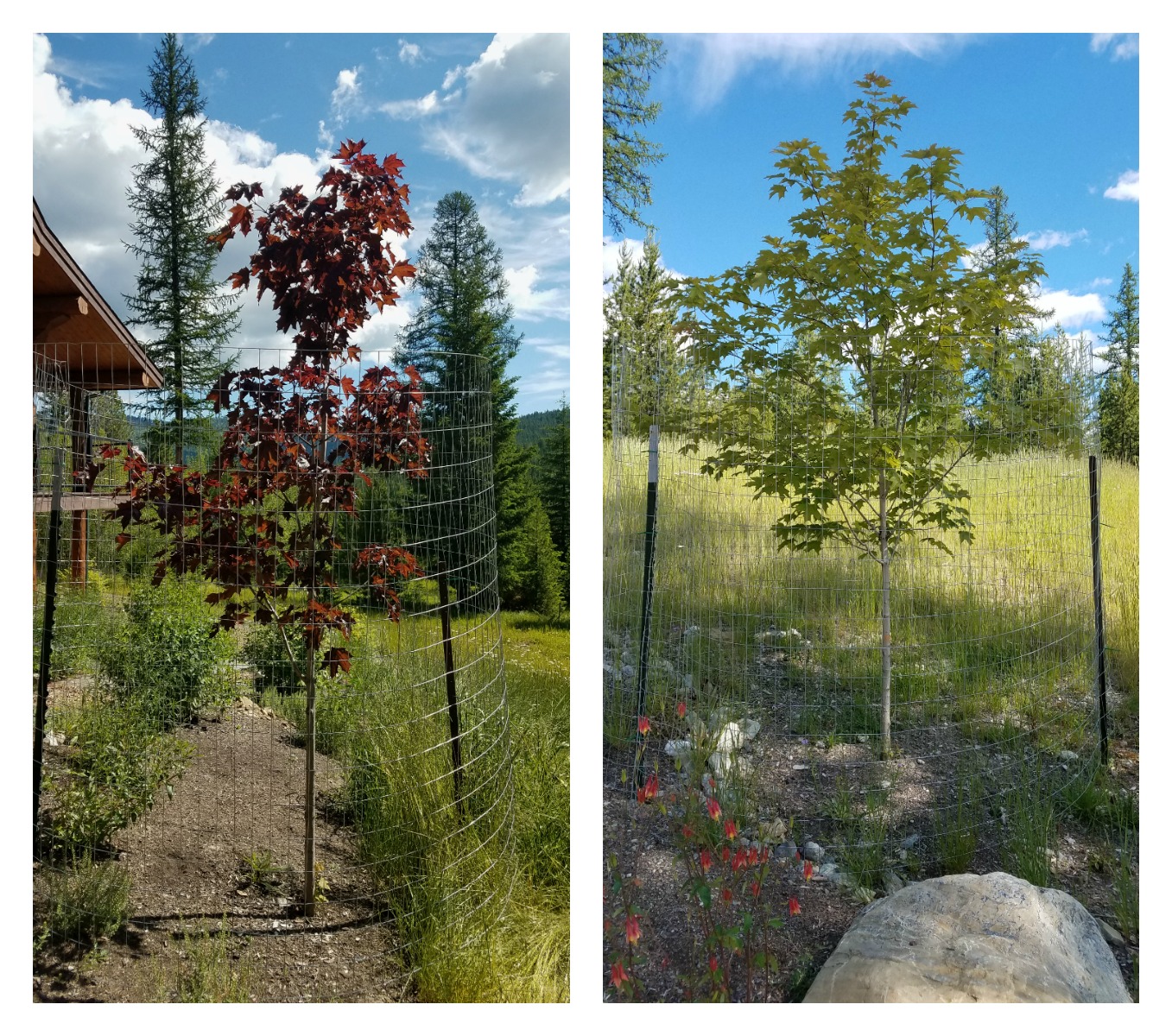
Similarly, the Norway Maple has been on a slow downward spiral ever since it was chowed by elk the first year.  This spring, it has not leafed out, and I am declaring it dead.  We have not decided what will replace it, but you can be sure it will be a native plant!

Gardens can also benefit from structures for visual interest and texture.  This summer, we have added "lawn art" in several locations.  We are still looking for a large piece, to be placed in the middle of the leach field.  In our mind's eye, we envision part of an old tractor, or perhaps a windmill from a dis-used ranch.


Jokingly, I often ask Montana natives how long you have to live here to qualify.  They chuckle, and politely change the subject.  So, when I read this sentence in the book "Braiding Sweetgrass: Indigenous Wisdom, Scientific Knowledge, and the Teachings of Plants" by Robin Wall Kimmerer, I was over the moon.  "For all of us, becoming indigenous to a place means living as if your children's future mattered, to take care of the land as if our lives, material and spiritual, depended on it."  Now that, my friends, I can do. 


Welcome to Mosaic Monday, a weekly meme where we get together to share our photo mosaics and collages.
Please include at least one photo mosaic/collage in your post.
The link will be open from 1 p.m. Sunday until 11 p.m. Tuesday (U.S. Mountain time).
Remember to add the link to your Mosaic Monday post and not the one to your blog.
Please link back to this post so that your readers will be able to visit and enjoy more wonderful mosaics; taking the MM blog button from my sidebar is an easy way to link back.
As host I will visit every participant and leave a comment so that you know I stopped by.
Please try and visit as many other blogs as you can, especially those that join in later, so that everyone's creativity can be appreciated fully.
Thank you for joining in today and sharing your mosaics with us.


You are invited to the Inlinkz link party!

Click here to enter

Sunday, July 12, 2020

Mosaic Monday #88: Glory in the Garden


You knew it was only a matter of time (oops, that was last week's post!) guaranteed that I would wax lyrical about my garden again.  Can you believe it has been 8 weeks since my last garden post?  Muchos cambios, mis amigos, so let's take a look!

Overall, I have been pleased with the outcome of my seed planting (7 out of 13 have come up, and 3 of those were sown in the spring).  54%, barely better than "average", may not seem a palatable result, but, given all of the seeds were hand-collected from last year's garden and that this was my first attempt, I am satisfied.  It has already taught me a thing or two about how thickly (or not) to sow the seeds.  As you can see in some of the pictures below, I could have been a little more judicious.


I sowed Rocky Mountain Bee Plant in multiple locations, and although it came up gangbusters in every one, since then only about half of them are thriving.  Last September, I wrote about these plants, which showed up in our "prairie" on their own.  I collected a bunch of seeds, but left the rest, assuming they would sow themselves.  I have not seen a single one in the prairie.  Go figure!  (In the mosaic above, there must be 20 individual plants in that cluster.)  I am thrilled with the number of columbines that have sprouted, especially since this is a seed sown in the spring.  Given this response, I will focus on seeding columbines rather than trying to transplant little ones.  If you are paying attention (!), you may be asking why there are only six pictures in the mosaic, when I said 7 have sprouted.  Good for you!  


Rocky Mountain Penstemon has also sprouted in half of the locations where it was sowed.  I so admire this hearty plant, and its deep-throated purple flowers, that I am over the moon with this result.  You may also be wondering about the little blue markers you see in the mosaic.  Inquiring minds must be answered!  Three weeks ago, I used these skewer sticks and blue painter’s tape to create little flags denoting sites with emerging plants.  This meant I didn't have to continually reference my seeding plan, and more importantly, prevented me from accidentally "weeding" something I would like to preserve!  (Sometimes, I am not sure, and the flag merits a question mark!!!  I am now pretty confident this is a Rocky Mountain Penstemon - time to update the flag.)

Rocky Mountain Penstemon when it's "all growed up" 


When we first installed our landscaping in 2018, I built a relationship with the Center for Native Plants in Whitefish.  Hailey Moore, the Nursery Manager, has been immensely helpful in a variety of ways – from identifying native and invasive grasses to connecting me with other resources.  In the two years that we have had these sand cherries, I saw significant die-off in the spring.  The first year, I thought it might be “normal”, but I decided not to make any assumptions.  Hailey let me know that Montana State University (Schutter Lab) offers up to five free lab tests per year for Montana residents.  So, per the lab’s instructions, I sent off a healthy sample and a “diseased” sample of the sand cherry.   I also emailed pictures to the lab. 
In less than a week, I had the results from Dr. Eva Grimme: "I suspect that the shrubs are affected by environmental factors like a late frost this spring.  I also found very minor browning/discoloration in the vascular system, which could indicate a fungal canker.  I recommend you check if the branches are still green underneath the bark - this means that they are still alive and may recover.  Prune out the dead branches.  Make sure to sterilize your tools between cuts.  Focus on supporting shrub vigor by providing adequate water and nutrients during the growing season."  As you can see, the pruning was dramatic, but hopefully it will improve the vigor of the shrubs (I have four of them) in the future.  I will also make a note to protect them from frost next spring!
Lower right: after pruning  Other two: "NORMAL"!
If I was self-indulgent, I might be inclined to tell you about EVERY ONE of my plants, but this post would be as long as War and Peace!  A few of them deserve to be called out (and I will, below, but for now, I will let these mosaics speak for the plants.) 

And now for the plants that deserve a special mention.  First up is aspen fleabane.  It has spawned at least 7 volunteers, one as much as 20 feet from the original plant.
 
Given my upbringing in the Midwest, the maples are near and dear to me – I already am in love with their shape and can imagine the day when they tower over the house and cast plentiful shade!
The shape of this Catmint is wonderfully symmetrical – a perfect choice on the part of our landscapers for a position next to the flagstone path that leads to the front door.


The scarlet Gilia is a fascinating flower.  When first installed, the three plants appeared as you see in the mosaic below - tall and spindly with flowers scattered along its arch.  The next year, we had many volunteers, but they never rose much above an inch tall.  And this year?  Shazam – blooms all over the place.  It turns out that this two-year cycle is normal for the plant. 


As faithful readers know, we planted wild grass/wildflower seed mix our first fall in the house.  I have been very pleased with the results – many types of grass, flax, poppies, black-eyed susans, coneflower.  And a few lupines.  One of them actually bloomed this year, which is not too bad for only its second year!
Now that my garden is really coming along, “big picture” pictures are more appealing.

Nature continues introducing her own plants to my garden as you can see in the collage below.  I have shown you arnica in the past; this month I have been able to collect seeds and hope that will be another successful experiment next year.
The circular bed around the Douglas Fir in front of the house has been growing so vigorously that my metal moose was getting lost in it.  So, I shifted it and the other decorative lawn art about 5 feet to the left.  Voila!
Doesn't it look like he is chomping on the yarrow?
After an initial slow start, the flower pots on the deck, as well as the flower baskets on the jackleg fence, are thriving.
Of course, my battle with critters is ongoing, from ground squirrels to rabbits to deer.  It was intense for a week or two, including the morning I chased a bunny around the entire house while still in my pajamas!  And then suddenly, no bunny.  Dramatically reduced numbers of ground squirrels.  Maybe the badger family is having an impact!  
The picture at left is the one and only apple blossom we had this spring - no fruit this year.  And don't ask me about the aphid infestation on our golden currants!  


But then I wake up this morning and see this.  Every gardener has her trials, but they all fade into the background when a new bloom erupts in all its glory.  
(I may be slow in commenting due to an overnight camping trip.)


Welcome to Mosaic Monday, a weekly meme where we get together to share our photo mosaics and collages.

Please include at least one photo mosaic/collage in your post.
The link will be open from 1 p.m. Sunday until 11 p.m. Monday (U.S. Mountain time). 
Remember to add the link to your Mosaic Monday post and not the one to your blog. 
Please link back to this post so that your readers will be able to visit and enjoy more wonderful mosaics; taking the MM blog button from my sidebar is an easy way to link back. 
As host I will visit every participant and leave a comment so that you know I stopped by. 
Please try and visit as many other blogs as you can, especially those that join in later, so that everyone's creativity can be appreciated fully. 
Thank you for joining in today and sharing your mosaics with us.  


You are invited to the Inlinkz link party!
Click here to enter

Sunday, June 9, 2019

Mosaic Monday #31 - How Does Your Garden Grow?

Blue Columbine
My April 14 post, Anticipation, had me dreaming about the wild grass and wildflowers that we sowed in the fall.  I also speculated about our formal landscaping - would it return?  Would there be self-seeding?  Would the apple trees bloom and cross-pollinate?  And then we have the pines and the aspens we transplanted at the end of the summer.  Did they survive?  Since I know you have all been on the edge of your seats waiting for the answers, this post will put your inquiring minds to rest.


I began keeping a garden journal on April 21; on a weekly basis, I note observations about each of the plants, and take pictures.  I am also tracking key events such as rainfall.  I am confident that in years to come, my notes will become my own mini-Farmer's Almanac for planning purposes.  Call me crazy, but this approach and its future application gets me jazzed!


If I went all-out with this post, it would contain over 25 mosaics to document plant progress since April.  This is good news because it means that most of the landscaping survived the winter, but even I think that's too much.  Perhaps I will focus on the most dramatic transformation, or my favorite plants.  Let's start and see where this goes.

BEE BALM: I am excited to have several of these plants in our garden since they are a magnet for bees, butterflies and hummingbirds.  Last year, they did not bloom; I am hoping the second year in the ground will make a difference.
Left to right: April 21 through June 2; all other collages will follow
a similar format
COLUMBINE: My love affair with this flower began when I saw a plethora of yellow columbine along the Highline Trail in Glacier National Park.  Our garden contains red and blue columbine, although some of the flowers seem to vary from what was on the official tag.  Never mind, they are delicate and unique and I never tire of looking at them.
Red Columbine

WILD STRAWBERRY: You might be surprised to know that wild strawberry flourish in this mountain climate; the plant is among the first to sprout and bloom.  Of course, this also means they are very attractive to hungry critters in the spring.  This plant was chowed down to the ground at the end of April, and has been nibbled at least once since then while making a comeback.

PAINTBRUSH: If you've never seen one of these, the pictures will soon reveal the source of its name.  Paintbrush is a sought-after prairie beauty that prefers bright sites with medium dry soils.  Its vivid bracts nearly hide small greenish flowers.  These plants are seldom grown in gardens because they are partly parasitic and require the roots of a host plant to survive.

GOLDEN CURRANT: an ornamental shrub with fragrant, yellow trumpet flowers, this drought tolerant plant should produce sweet, golden seedy fruit within three years of planting.  Given the maturity of these shrubs when they were planted last summer, fruit this year is a distinct possibility.
The currants were the first of our shrubs to leaf out

WESTERN SAND CHERRY: This small shrub has grayish-green leaves that turn purple in the fall.  The mass of white flowers along the branches in the spring are followed by large quantities of purple-black fruits in summer.  Unfortunately, as you can see in the upper middle photo of the collage below, a couple of the sand cherries show significant withering.  I discussed it with our landscaper, and he asked if aphids were present.  By the time the damage was visible, if it was aphids, they had moved on.  I suspect it was aphids since I have now discovered the little sap suckers on our burning bushes!

WILD GRASS/WILDFLOWER SEED: Last fall, we scattered 30 pounds worth of wild grass seed, mixed with wildflower seed.  We were equal parts hopeful and skeptical, given 1) the seed is sown in soil that has been scored to loosen it - so, essentially, the seed is lying on top of the soil, 2) the target areas were disturbed and in some cases compacted during construction, and 3) birds and other critters would have an opportunity before snow fall and after snow melt to gobble up the seed.  I am pleased to report that hopeful won out in this case - we have a healthy crop of grass (that we don't have to mow) - the wildflowers will take a little longer to see.

TRANSPLANTS: In my November 7, 2018 post, I wrote that we had transplanted no less than 2 juniper, 18 aspen, 5 Engelmann spruce, 2 Douglas fir and 9 larches.  As spring approached, I recalled my days as a pregnant woman - anxiety mixed with joy as I anticipated our success rate.  AND?  The spruce and the fir are not showing new growth, but the needles feel soft, which means they are still alive.  (A dead tree would drop its needles at the merest touch, much like a dried-out Christmas tree.) The juniper have green tips, and 17 out of 18 of the aspen have leaves, with most of them fully leafed out.  I cannot say we have enjoyed such a ratio with the larch - only 4 out of the 9 greened up, and one more is questionable.  Sigh.  Good thing we have plenty of young larch to draw from elsewhere on our property when we try again in the fall!
Upper left: aspen; lower left: juniper
Top and bottom right: larch

ROYAL RED NORWAY MAPLE: If you've been following my blog for a while, you will recall that this maple was subject to some severe "pruning" by elk last fall.  It's still a little lopsided, but the overall condition is better than I expected when the elk left it with little more than a "poodle tail"!

FALL FIESTA SUGAR MAPLE: Now, this is a tree!  You can take the girl out of the Midwest, but you can't take the Midwest out of the girl!  Something about the leaf shape, the contour of the tree, its fullness - ah, that's a tree!

APPLE TREES: I saved the best for last!  The Honeycrisp was planted to honor my Father, a life-long gardener who taught me most of what I know about nurturing a landscape (he passed away in April 1998).  When I was a young girl, we had Winesap and Golden Delicious trees - so many sweet memories are tied to that small orchard.

As it turns out, a Honeycrisp needs another apple tree for pollination, so it seemed only fitting to dedicate the second tree, a Goodland, to my Mother.  It was a blessing that my Mom was here last September to harvest the first apples from her tree.  As I watch the bees and other pollinators buzz about the blossoms, I think of my parents, and I wish my Dad could have been here for one of his famous "garden tours", only this time I would be giving the tour.  This post is for you, Dad!
Elk also "pruned" the Goodland but it has made a full recovery

Welcome to Mosaic Monday, a weekly meme where we get together to share our photo mosaics and collages.
Please include at least one photo mosaic/collage in your post.
The link will be open from 1 p.m. Sunday until 11 p.m. Monday (U.S. Mountain time).
Remember to add the link to your Mosaic Monday post and not the one to your blog.
Please link back to this post so that your readers will be able to visit and enjoy more wonderful mosaics; taking the MM blog button from my sidebar is an easy way to link back.
As host I will visit every participant and leave a comment so that you know I stopped by.
Please try and visit as many other blogs as you can, especially those that join in later, so that everyone's creativity can be appreciated fully.
Thank you for joining in today and sharing your mosaics with us.


You are invited to the Inlinkz link party!
Click here to enter
Related Posts Plugin for WordPress, Blogger...