 |
| Blue flax - from wildflower seed scattered last fall |
In my previous garden posts (June 9 and July 21), I have featured 70% of my formal plantings. Today you will see the remainder, again through collages illustrating their progression since the snow melted! (Click on the collage to make it bigger.)
 |
I always thought of Goldenrod as "common" - but it has
"grown" on me - LOL!
|
 |
| Bee Balm was in my June 9 post, but before blooming |
 |
Coreopsis - in the upper middle photo, the plants are
barely visible. They exploded into my most prolific plant,
all by self-seeding. I transplanted many of them just to
make the flower bed look a little more shapely (lower middle
shot is "after"). This is also the plant most plagued by deer.
|
 |
Aster - far right plant was drastically nibbled by deer
earlier this summer - silver lining? Abundant flowers
on the ends of multiple stems
|
 |
Prairie coneflower - I love this plant. Began blooming in
mid-July and is still full of color. Knock on wood, deer
don't bother it.
|
 |
Goodland apple - I wrote about the apple trees in my
June 9 post - at that time, they were still in flower. The
Goodland has 12 apples. We beefed up the protection on
this tree after the 1 small apple on the Honeycrisp
disappeared. Suspect? Chipmunks.
|
 |
Scarlet Gilia - given its delicate nature last summer, I was surprised it returned at all.
I have since learned by observation that it does not grow back from its base, but only
by self-seeding - we must have over 140 "volunteers". I have also learned from visiting
the nursery that it will not flower this year but next.
|
 |
Russian Sage - another love. As you can see, it grows back from its base and becomes
this sprawling web of purple. And the deer don't bother it.
|
 |
Black-eyed Susan: another plant that returns only via self-seeding. It takes a keen eye to spot
these "volunteers", and some patience to see how they develop before deciding to keep or
to pluck. Shortly after the last picture, deer came along and ate this bloom and several of
the buds closest to opening. Grrrr ….
|


As you can see from some of these pictures, the “formal” landscaping is quickly outgrowing its defined boundaries. I am torn between a desire for “order”, and the joy of nature doing its thing. Just given my personality, this will be an ongoing tussle, but I am determined to encourage a natural garden, so “disorder” is the preferred condition. This means allowing many plants to grow until I can figure out what they are – the benefit is less weeding (at first)! Each time I realize I have a new volunteer, it’s like a instant shot of joy.

 |
Clockwise from upper left: Larkspur; Coreopsis variant; Lupine; Purple Coneflower; Blue Flax; Black-eyed Susan
I learned that Blue Flax flowers last less than 24 hours. I took the above picture in the morning and I was glad I did!
|
 |
| Yarrow |


 |
Lower middle is Cheatgrass - highly invasive. Fortunately, I only found two small patches of it - pulled it up
carefully - trying not to spread seeds - and threw it away. Only three of these matched the list given to me
by Hooper's. Go figure!
|
While I am enjoying the plants which are blooming in the garden now, half of me has already turned my attention to next year’s garden. At the end of July, seeds were ready to be harvested from both columbine and blanket flower plants. Since then, I have also collected the following seeds: aspen fleabane, lupine, chives, goldenrod, nodding onion, aster, coreopsis, rocky mountain penstemon, red poppy, bee balm, coneflower and yarrow. It gave me great joy yesterday to give some seeds to a friend who recently moved into her new house.


 |
| Red Osier Dogwood |

We will be adding some top soil to the area, and then fall seeding will begin using the design you see below. The Red Osier Dogwood will go in the hole – it is meant to provide some contrast with the pines, and to anchor that end of the flower bed. A few transplants, such as juniper, will complete the fall planting and we will let Mother Nature do her work until it is time for spring planting of the other seeds. I am so excited to see how this develops.

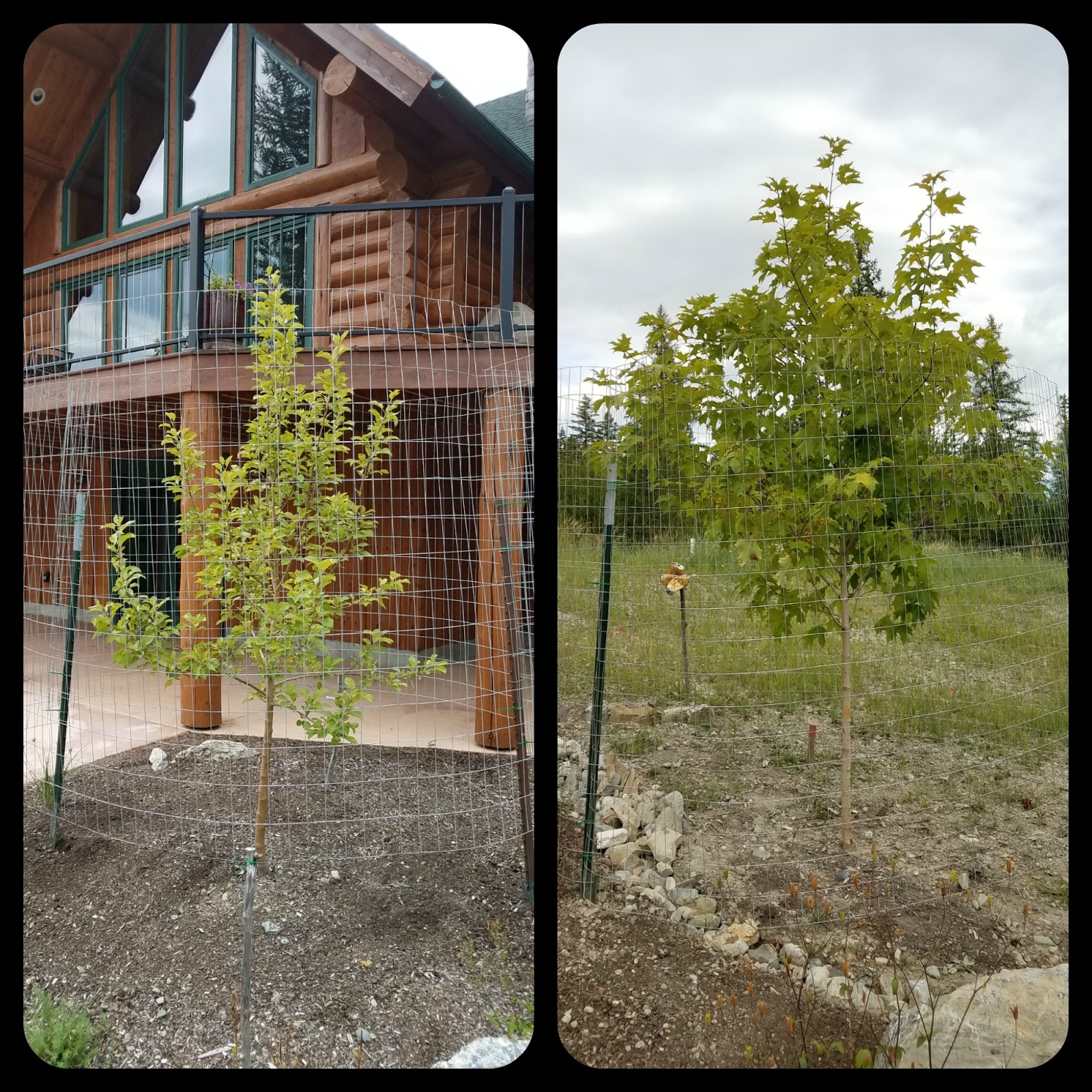
Re-focusing on events closer on the time horizon, I wanted to get a jump on the deer and/or the elk that might take a shine to the apple trees and maples. (You may remember my post from September 29 last year, when elk had seriously pruned one of my maples and also nibbled the apple trees.) Not this year, my friends – we bought taller caging material and put it around both maples and the apple trees.


Welcome to Mosaic Monday, a weekly meme
where we get together to share our photo mosaics and collages.
Please include at least one photo mosaic/collage in your post.
The link will be open from 1 p.m. Sunday until 11 p.m. Monday (U.S. Mountain time).
Remember to add the link to your Mosaic Monday post and not the one to your blog.
Please link back to this post so that your readers will be able to visit and enjoy more wonderful mosaics; taking the MM blog button from my sidebar is an easy way to link back.
As host I will visit every participant and leave a comment so that you know I stopped by.
Please try and visit as many other blogs as you can, especially those that join in later, so that everyone's creativity can be appreciated fully.
Thank you for joining in today and sharing your mosaics with us.
Please include at least one photo mosaic/collage in your post.
The link will be open from 1 p.m. Sunday until 11 p.m. Monday (U.S. Mountain time).
Remember to add the link to your Mosaic Monday post and not the one to your blog.
Please link back to this post so that your readers will be able to visit and enjoy more wonderful mosaics; taking the MM blog button from my sidebar is an easy way to link back.
As host I will visit every participant and leave a comment so that you know I stopped by.
Please try and visit as many other blogs as you can, especially those that join in later, so that everyone's creativity can be appreciated fully.
Thank you for joining in today and sharing your mosaics with us.

