Showing posts with label Larkspur. Show all posts

Sunday, September 8, 2019

Mosaic Monday #44: Gardening Galore

Blue flax - from wildflower seed scattered last fall
I have so much to share with you, dear friends.  The ongoing transformation of my garden.  My burgeoning knowledge about the plants in this region.  The challenges of gardening in the woods with critters of all kinds. My embryonic plans for next year’s garden.  Are you seated comfortably?  Then let’s begin.

In my previous garden posts (June 9 and July 21), I have featured 70% of my formal plantings.  Today you will see the remainder, again through collages illustrating their progression since the snow melted!  (Click on the collage to make it bigger.)
I always thought of Goldenrod as "common" - but it has
"grown" on me - LOL!
Bee Balm was in my June 9 post, but before blooming
Coreopsis - in the upper middle photo, the plants are 
barely visible.  They exploded into my most prolific plant,
all by self-seeding.  I transplanted many of them just to
make the flower bed look a little more shapely (lower middle
 shot is "after").  This is also the plant most plagued by deer.
Aster - far right plant was drastically nibbled by deer
earlier this summer - silver lining?  Abundant flowers
on the ends of multiple stems
Prairie coneflower - I love this plant.  Began blooming in
mid-July and is still full of color.   Knock on wood, deer
don't bother it.
Goodland apple - I wrote about the apple trees in my
June 9 post - at that time, they were still in flower.  The
Goodland has 12 apples.  We beefed up the protection on
this tree after the 1 small apple on the Honeycrisp 
disappeared.  Suspect?  Chipmunks.
Scarlet Gilia - given its delicate nature last summer, I was surprised it returned at all.
I have since learned by observation that it does not grow back from its base, but only
by self-seeding - we must have over 140 "volunteers".  I have also learned from visiting
the nursery that it will not flower this year but next.
Russian Sage - another love.  As you can see, it grows back from its base and becomes
this sprawling web of purple.  And the deer don't bother it.
Black-eyed Susan: another plant that returns only via self-seeding.  It takes a keen eye to spot
these "volunteers", and some patience to see how they develop before deciding to keep or
to pluck.  Shortly after the last picture, deer came along and ate this bloom and several of
the buds closest to opening.  Grrrr ….

Speaking of deer – perhaps it is obvious that our “deer defense” system has ceased to be effective.  I guess those clinking beer/cat food cans are now music to their ears!  Few plants have been immune to their affections, but the coreopsis below the mudroom has been nibbled almost every night for the last month.  Good thing I have a lot of it – I have deliberately left some sections uncovered in the hopes that the deer will focus on those.  Friday we installed an “Animal Repeller” – when it senses an animal, it emits a high-pitched noise, and if at night, flashes a strobe light as well.  So far? Mixed results since I do have deer tracks this morning.  Might need to move it slightly.  This has also taught us that we need to change up the defense system.  Cans for a period, then sparkly ribbons, then the repeller, and so on.

Black aphids also returned to the pearly everlasting and the yellow penstemon in mid-August.  The good news?  The Columbian ground squirrels have gone into hibernation!!!  At least one less threat to deal with!

As you can see from some of these pictures, the “formal” landscaping is quickly outgrowing its defined boundaries.  I am torn between a desire for “order”, and the joy of nature doing its thing.  Just given my personality, this will be an ongoing tussle, but I am determined to encourage a natural garden, so “disorder” is the preferred condition.  This means allowing many plants to grow until I can figure out what they are – the benefit is less weeding (at first)!   Each time I realize I have a new volunteer, it’s like a instant shot of joy. 
It is much easier for me to accept “chaos” in our “prairie”, which you may recall was planted with a grass seed/wildflower seed mix last fall.  It’s the gift that keeps on giving – I can almost always find something new out there. 
Clockwise from upper left: Larkspur; Coreopsis variant; Lupine; Purple Coneflower; Blue Flax; Black-eyed Susan
I learned that Blue Flax flowers last less than 24 hours.  I took the above picture in the morning and I was glad I did!

Yarrow
It seems each day brings new learning for me, and from a variety of sources.  Most of it is plain observation.  For example, the aster plant that was significantly pruned by deer produced the most flowers.  And once a plant is flowering, the deer don’t eat it.  And I have been amazed (and pleased) that most of our plants are as advertised – they thrive even in our dry conditions.  Of course, the Web is a superb source of information, but sometimes you need a fellow human, and in that case, the Center for Native Plants has been a god-send.    While the wildflowers have been easy to identify, the grasses have been much more difficult.

I called Hooper’s Garden Center (which provided the grass/wildflower mix), and they gave me a list of grasses that was included in the mix.  I studied each of them, even sketching diagrams in my garden journal, and teaching myself about grass anatomy.  Unfortunately, most of them did not seem to match the grasses outside.  I reached out to a friend who works for the Forest Service, and he recommended two sources: the book “Plants of the Rocky Mountains” and the Center for Native Plants in Whitefish. 

I ordered the book and it was helpful to identify some of the grasses, but I still had gaps.  So, on one of my weekly trips to Whitefish, I stopped in the Center and talked with Sarah about my challenge.  She referred me to the nursery manager, Hailey.  She suggested Hailey might come out to our house (for a fee plus gas), but that she might also be able to identify the grasses just from pictures.  Sold!  That night I sent off a series of emails to Hailey, and within a few days she had responded.  Most importantly, she was able to tell me that only one of the grasses is highly invasive. 
Lower middle is Cheatgrass - highly invasive.  Fortunately, I only found two small patches of it - pulled it up
carefully - trying not to spread seeds - and threw it away.  Only three of these matched the list given to me
by Hooper's.  Go figure!

While I am enjoying the plants which are blooming in the garden now, half of me has already turned my attention to next year’s garden.  At the end of July, seeds were ready to be harvested from both columbine and blanket flower plants.  Since then, I have also collected the following seeds: aspen fleabane, lupine, chives, goldenrod, nodding onion, aster, coreopsis, rocky mountain penstemon, red poppy, bee balm, coneflower and yarrow.  It gave me great joy yesterday to give some seeds to a friend who recently moved into her new house.
At least half of my seeds are to be planted in the fall, so I am creating to-scale drawings of each of my flower beds, including all the volunteers.  This will allow me to decide where to augment the landscape, taking into account size, color and the time frame for blooming.  I would like to make sure that every flower bed has something in bloom at all times.

Red Osier Dogwood
In early August, we transformed the area near our “address rock”.  Our neighbor on the hill had previously given us nearly 20 rocks, and had carefully arranged them in a semi-circle using his tractor.  After driving by it numerous times, I decided for a different look, and he willingly came down the hill with the tractor and re-arranged them in real time.  And gave us a scoop of dirt.  And dug a hole for a dogwood we plan to place there.  What a pal!  The barter system is alive and well in Montana; he was happy to help us out in exchange for the water he has been able to access from our well head throughout the summer! 

We will be adding some top soil to the area, and then fall seeding will begin using the design you see below.  The Red Osier Dogwood will go in the hole – it is meant to provide some contrast with the pines, and to anchor that end of the flower bed.  A few transplants, such as juniper, will complete the fall planting and we will let Mother Nature do her work until it is time for spring planting of the other seeds.  I am so excited to see how this develops.

Re-focusing on events closer on the time horizon, I wanted to get a jump on the deer and/or the elk that might take a shine to the apple trees and maples. (You may remember my post from September 29 last year, when elk had seriously pruned one of my maples and also nibbled the apple trees.)  Not this year, my friends – we bought taller caging material and put it around both maples and the apple trees. 
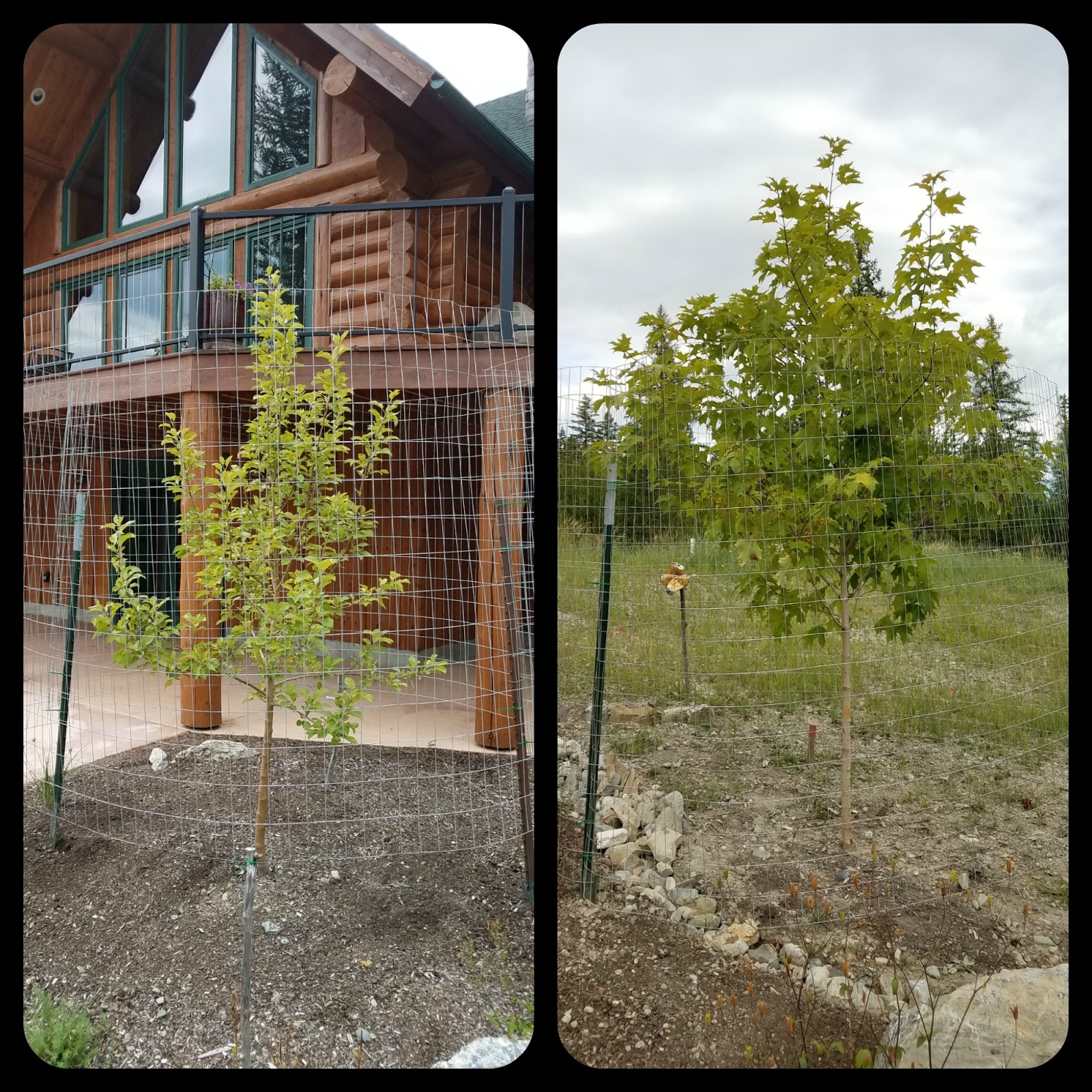
Soon we will harvest the apples to prevent them from attracting bears.  And frost might nip away at my flower pots as early as next week.  But in the meantime, I will relish all the beauty that they have to offer.  


Welcome to Mosaic Monday, a weekly meme where we get together to share our photo mosaics and collages.
Please include at least one photo mosaic/collage in your post.
The link will be open from 1 p.m. Sunday until 11 p.m. Monday (U.S. Mountain time).
Remember to add the link to your Mosaic Monday post and not the one to your blog.
Please link back to this post so that your readers will be able to visit and enjoy more wonderful mosaics; taking the MM blog button from my sidebar is an easy way to link back.
As host I will visit every participant and leave a comment so that you know I stopped by.
Please try and visit as many other blogs as you can, especially those that join in later, so that everyone's creativity can be appreciated fully.
Thank you for joining in today and sharing your mosaics with us.
 
You are invited to the Inlinkz link party!
Click here to enter

Wednesday, June 6, 2018

My Hiking Journal: Entry 11


Glacier Lilies
Sunday, July 2, 2017 - Jewel Basin - 10 mile loop with 1800 feet net elevation gain

"We did it!  Back on June 5, 2017 (entry 10), we were thwarted in our attempt to start a hike from the Camp Misery trailhead … but today, success!"

So begins my journal entry for this hike, almost a full year ago.  But you should read on for the 'rest of the story'.


"It was not without its trials … there was still a lot of snow on the trails.  This meant it was physically more demanding than normal hiking.  Also, at the intersection of trail 55 and trail 7, there was so much snow and a lack of trail signs that it was impossible to figure out the location of the trail.  The topographical map was a huge help, and we also crossed our fingers that some of the footprints in the snow were directionally correct."

As I noted in the margin of my journal, I was very pleased that we were calm and worked through it!

Ok, now that I have that out of my system, let's approach this a little more calmly.  Spring flowers were abundant (yes, at this elevation, July 2 is still 'spring').
Upper left: Red Paintbrush; Middle left: Elliptic-leaved Penstemon
Lower left: Mountain Buttercup
Upper right: Glacier Lilies and Western Pasqueflowers
Lower right: Man with Hat on rock

Along the way, we met a family planning to camp at Black Lake. At a few obscure points on the trail, we helped each other find the way.
Black Lake
At Black Lake, 3 guys and their 2 dogs were breaking camp.  They reported hooking cutthroat trout in the lake for their supper the previous night.
Creek leaving the foot of Black Lake

We cruised on and made our picnic break at Jewel Lakes.  We heard the three guys pass us by and thought nothing more of it.


From left to right: Yellow Columbine, Green False Hellebore, Yellow Columbine, Shooting Star

However, as we ascended past Blackfoot Lake, we heard gunshots, and it was impossible to determine the source.  We started shouting and continued the racket for quite a while.  Some distance on, we came across the same 3 fellows, and learned that they had been doing some 'target shooting' at dead trees.  Swell.
Beargrass surrounds Man with Hat

Climbing, climbing.


Blackfoot Lake; saw two bald eagles flying around lake


Yes, this is the trail!
Met a group of 5 heading the other way, planning to camp at Blackfoot.  About this time it was getting quite warm and I could not imagine that this much snow was still around.  I used snowballs to help cool down … at one point, we MIGHT have had a good old-fashioned snowball fight!


Enter the hour of trail confusion.  I won't belabor the point I made at the beginning of this post, other than to say snow can be a blessing (you can see every footprint) and a curse (you can see every footprint).  Once we worked through it, we were rewarded with the view of Twin Lakes.  Worthy of a break.
Top: Western Pasqueflower
Center left: Paintbrush and Western Virgin's Bower
Center right: Larkspur


Upon returning to the trailhead, as I was taking off my boots and sweaty socks (too much information?), I felt victorious, confident, reassured, relieved and pleasantly tired.  Accompanied by a healthy respect for snowpack in July at 6,000 feet. 


Linking to

All Seasons

Floral Friday Fotos
Copy this image and its link to place on your blog

Mosaic Monday


Nature Notes

Friday, February 2, 2018

My Hiking Journal - Entry 8

Monday, May 29, 2017 - Echo Broken Leg Trail - 9 miles out and back

Larkspur
Yesterday morning, I was sipping my coffee and working up the motivation to get out of bed.  (Nothing bad - just nowhere particular to be, and my window offered a view onto the snow falling heavily outside.  So, why get up?)  My mind turned to my next blog post, and with amazement I considered that in 16 weeks, it will have been a year since we roamed this trail.


Wow.  That means Montana has been home for almost 8 months.

Starry False Solomon's Seal
That means we will soon be hiking again (without Traxx or snow shoes)!


That means spring flowers ARE under yesterday's snow, slumbering peacefully.

While we are waiting, let's pretend it's May, and go for a stroll.

In my hiking journal, this trail earned a couple of exclamation points. 

For the first time in the 2017 season, we saw bear grass in bloom!


Bear grass is an iconic symbol of Glacier National Park - you will find it on postcards, t-shirts and mugs everywhere.  A unique aspect of this plant is that its colonies typically only bloom every five to seven years.

Since you see bear grass every summer, it means that there are always colonies in bloom while others are 'resting.'  The plant is found mostly in western North America, from British Columbia south to California and east to Wyoming, in subalpine meadows and coastal mountains.  My heart exploded with joy when I saw the ethereal blooms along the path!


Payette Beardtongue - only found in Idaho, Montana
and Oregon
This trail was an easy trek, as it roughly winds along a hillside without gaining much elevation.  And the south-facing aspect delivered a proliferation of wildflowers relatively early for the time of year, hence another exclamation point!

Upper left - Western Meadow Rue (male); Upper right - Heartleaf Arnica and Oregon Grape
Lower left - Coreopsis; Lower right - Fernleaf Biscuitroot

We crossed three major streams along the way.  Given the spring run-off, we were grateful for bridges over each of them.  Here's a video near one of the crossings.  Don't you just love the sight and sound of running water?


The last half-mile of the trail, trees became sparser, opening vistas to the valley and even more wildflowers on the rock screes above and below the path.  I was beside myself with the variety and quantity of the flowers - I couldn't wait to get home and identify all of them. Man with Hat was very patient as I snapped away with my phone camera.  Can you see him waiting for me, ahead at the turn of the trail?

Middle - Yellow Violets; Lower left - Fernleaf Biscuitroot and Chokecherry
Lower right - Thimbleberry
Paintbrush
The track continues over Wolf Creek; without a bridge, your choices are to
1) get your boots (and more) wet, 2) take off your boots and slip your way across mossy rocks while withstanding the bone-chilling water, or 3) attempt to use a fallen log for the crossing (only recommended if your last name is Wallenda).  Look how fast the water was running here ...

Left -  Biscuitroot and Larkspur; Upper right - Wood's Rose
Lower right - Foothill Death Camas
So we followed the spur above Wolf Creek, which led to a rocky outcropping, an ideal location for our picnic lunch.  Flattened plants and signs of a recent campfire let us know that someone had taken advantage of the spot for camping.  Come May 2018, that might be us!
Left - Arrowleaf Balsamroot; Right - False Solomon's Seal

Linking to:


Related Posts Plugin for WordPress, Blogger...